
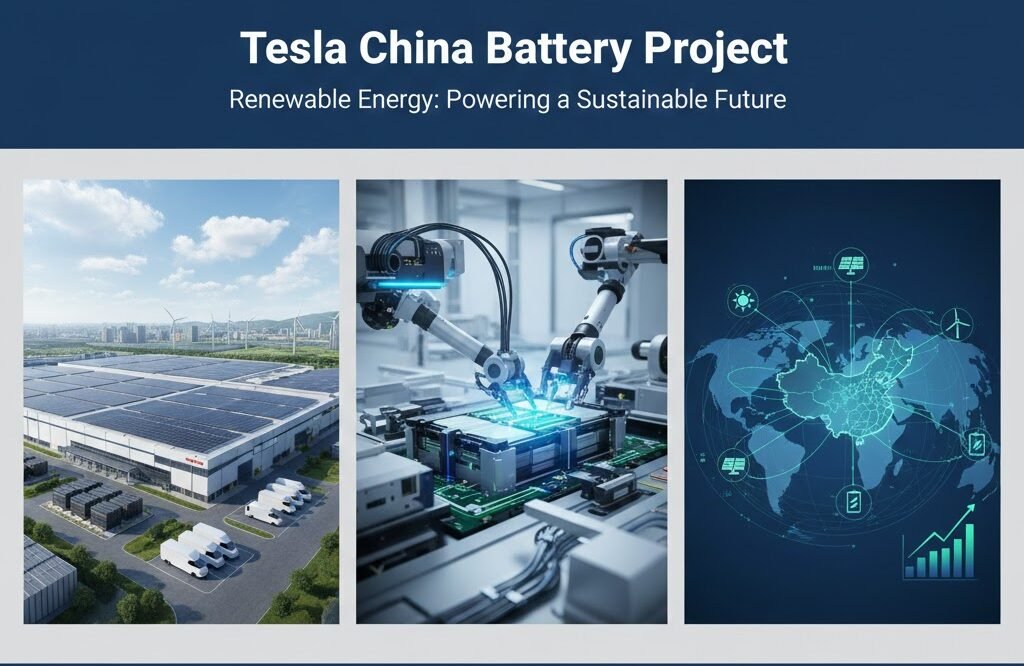
Introduction: Understanding the Tesla China Battery Project Renewable Energy Vision
The Tesla China battery project renewable energy initiative marks a critical juncture in the transition toward cleaner, more resilient power systems in one of the world’s largest energy markets. This project combines advanced battery storage with renewable power integration, aiming to reduce carbon emissions, stabilize electricity grids, and support China’s ambitious climate targets. As global demand for reliable renewable energy grows, this project stands as both an engineering milestone and a strategic example of how electrification and sustainability can go hand in hand.
Tesla’s push into battery storage—not just electric vehicles—is reshaping the role of energy infrastructure worldwide. In China, this shift represents a convergence of renewable energy expansion and technological deployment, paving the way for a more flexible and decarbonized grid. Through this article, we’ll explore the breadth of the Tesla China battery project renewable energy strategy, from its origins and technologies to its economic and environmental implications.
What Is the Tesla China Battery Project Renewable Energy Initiative?
A New Era of Energy Storage in China
The Tesla China battery project renewable energy initiative centers on building large‑scale battery energy storage systems (BESS) using Tesla’s Megapack technology in Shanghai’s Lingang New Area. Announced through a multi‑billion‑yuan agreement with the Shanghai municipal government and China Kangfu International Leasing, this project represents Tesla’s first grid‑side energy storage deployment in the Chinese mainland.
Battery energy storage systems like those used by Tesla are critical for integrating volatile renewable sources—such as wind and solar—into the power grid. These grid‑scale systems store electricity when generation exceeds demand and release energy during peak usage, smoothing supply fluctuation and ensuring stability.
How the Project Supports Renewable Energy
Renewable energy such as solar and wind produce clean power but often generate electricity intermittently. By combining this with the Tesla China battery project renewable energy storage framework, excess renewable output can be stored and dispatched when needed, rather than wasted. This synergy supports greater penetration of renewables, making China’s energy grid more resilient and less dependent on fossil fuels.
Key Milestones and Timeline
Groundbreaking and Construction
The groundwork for the project began with the establishment of Tesla’s new Megafactory in Shanghai, built to manufacture Megapack storage batteries. This facility was constructed in record time, highlighting Tesla’s operational “speed” and commitment to electrification infrastructure.
Trial and Full‑Scale Production
By early 2025, Tesla’s Shanghai battery plant had entered trial production, with full commercial output expected shortly after. The factory has an annual capacity of about 40 GWh, equivalent to around 10,000 Megapack units. These batteries can store large amounts of electricity—sufficient to power thousands of homes—making them vital for renewable energy integration.
Export and Global Integration
In addition to serving the domestic Chinese market, Tesla has already started exporting Megapacks produced in Shanghai to countries like Australia. This export activity signals that Tesla’s China‑based battery production will contribute not just locally, but globally, to renewable energy deployment.
The Technology Behind Tesla’s Battery Solutions
Megapack: The Backbone of the Project
At the heart of the Tesla China battery project renewable energy initiative is the Megapack—a utility‑scale lithium‑ion battery system designed for large‑scale energy storage. These systems can store up to several megawatt‑hours of energy in each unit. When combined into a larger facility, they provide robust grid storage capacity, capable of shifting power from periods of low demand to peak usage hours.
With advanced inverter technology and smart control systems, Megapacks help stabilize voltage and frequency on the grid. This is especially critical when renewable sources like solar and wind produce fluctuating power outputs based on weather conditions.
Integration with Smart Grid Services
Beyond energy storage, the project’s batteries participate in ancillary grid services such as peak shaving, frequency regulation, and spot electricity trading. This means the battery systems don’t just store power—they actively contribute to optimizing grid performance and economic efficiency.
Economic and Industrial Impact in China
Boosting Local Investment and Job Creation
The Tesla China battery project renewable energy initiative also provides economic benefits by generating investment and local employment. Construction and operation of the battery facilities create direct and indirect jobs—from manufacturing to installation and maintenance—underscoring the value of green infrastructure development.
Enhancing China’s Industrial Leadership
China already dominates global battery production, exporting billions of units and supporting vast renewable installations worldwide. The addition of Tesla’s Megafactory reinforces China’s position as a global hub for clean technology manufacturing, further stimulating innovation and investment in renewable energy sectors.
Environmental and Climate Benefits
Supporting China’s Climate Goals
China aims to peak carbon emissions before 2030 and achieve carbon neutrality by 2060. Energy storage projects like Tesla’s play an essential role in these goals by enabling higher shares of renewable energy while mitigating reliance on fossil‑based backup power. The ability to store and dispatch clean electricity reduces greenhouse gas emissions and supports the transition to a low‑carbon economy.
Reducing Grid Reliance on Fossil Fuels
By absorbing surplus renewable generation and reducing the need for gas or coal backup plants during peak demand, the Tesla China battery project renewable energy scheme lowers overall carbon intensity of electricity generation. This aligns with global efforts to decarbonize energy systems and slow climate change.
Challenges and Considerations
Regulatory and Grid Integration Hurdles
Large‑scale battery storage still faces regulatory and technical barriers, particularly in harmonizing grid codes and balancing supply‑demand requirements. Integrating battery systems into existing grid infrastructure requires careful planning to ensure safety, reliability, and interoperability.
Cost and Return on Investment
Although battery storage costs have decreased over time, the initial investment for grid‑scale storage remains significant. Projects must demonstrate long‑term economic value through energy arbitrage and ancillary service revenues—especially when competing with traditional fossil fuel solutions.
Future Prospects and Expansion
Scaling Renewable Integration
Looking ahead, the Tesla China battery project renewable energy model could scale across other provinces and regions within China. As more renewable capacity is added, grid storage offers a flexible platform for managing load variability and supporting electrification.
Global Replication Beyond China
Tesla’s success in China may influence similar projects elsewhere, from Europe to Southeast Asia. As renewable energy costs decline and grid storage technology matures, global deployment of battery projects is likely to accelerate, contributing substantially to decarbonization efforts worldwide.
Conclusion: The Strategic Importance of the Tesla China Battery Project Renewable Energy Initiative
The Tesla China battery project renewable energy initiative is far more than a large‑scale battery deployment. It’s a cornerstone of future energy systems that prioritize sustainability, stability, and economic growth. By integrating renewable energy sources with advanced storage technologies, Tesla and China are charting a course toward resilient, decarbonized power grids.
This project exemplifies how public‑private collaboration can accelerate clean energy transitions while delivering tangible benefits for communities and industries. As the world seeks solutions to climate change and energy security, initiatives like this offer a blueprint for scalable, impactful action.
5 Frequently Asked Questions (FAQs)
1. What is the Tesla China battery project renewable energy initiative?
It’s an energy storage project in Shanghai using Tesla’s Megapack batteries to support grid stability and renewable energy integration across China.
2. How does this project support renewable energy growth?
The project stores excess power from renewable sources like solar and wind, then dispatches it during peak demand, smoothing power supply fluctuations.
3. What technology does Tesla use in this project?
Tesla’s Megapack lithium‑ion battery systems form the core technology, offering large‑scale, utility‑grade energy storage with smart grid capabilities.
4. Will the project have economic benefits in China?
Yes, it stimulates local investment, creates jobs, and reinforces China’s leadership in clean energy manufacturing.
5. Can this model be used in other countries?
Absolutely—similar grid‑scale battery projects are emerging globally as nations seek to enhance renewable integration and grid resilience.