
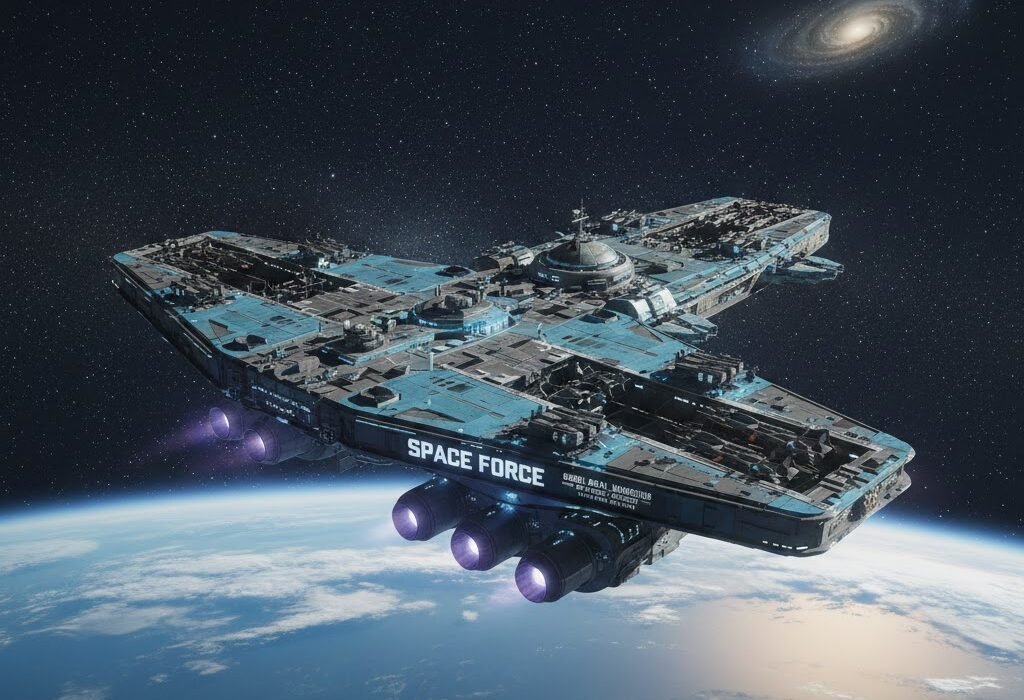
The idea of a space force orbital warship carrier is no longer limited to science fiction novels or blockbuster movies. As space becomes an increasingly contested domain, military strategists, defense analysts, and policymakers are openly discussing orbital defense platforms that could protect satellites, deter threats, and project power beyond Earth’s atmosphere. In today’s rapidly evolving security environment, this concept represents a major shift in how nations think about warfare, deterrence, and strategic dominance in space.
This article explores what an orbital warship carrier could realistically be, why it matters, how it might function, and what challenges stand in the way of turning this ambitious concept into reality.
Understanding the Space Force Orbital Warship Carrier Concept
At its core, a space force orbital warship carrier refers to a large, space-based platform designed to operate in Earth’s orbit while supporting multiple smaller spacecraft, defensive systems, and mission modules. Unlike traditional naval carriers, this platform would not deploy fighter jets across oceans. Instead, it would manage fleets of orbital vehicles, drones, and satellites dedicated to surveillance, defense, repair, and deterrence.
The concept aligns with the growing recognition that space is no longer just a support domain. Modern economies, communications, navigation systems, and military operations all rely heavily on space-based assets. Protecting these assets has become a strategic priority.
Why Orbital Warship Carriers Are Being Discussed Now
Several global trends have pushed the idea of orbital carriers into serious discussion:
Increasing Dependence on Space Infrastructure
Modern societies rely on satellites for GPS, weather forecasting, financial transactions, and communications. Disrupting these systems could cripple economies and defense capabilities without firing a single missile on Earth.
Growing Space Competition
Multiple nations are developing anti-satellite technologies, electronic warfare tools, and space-based surveillance systems. This competition has made orbital defense a central concern for national security planners.
The Creation of Dedicated Space Forces
The establishment of independent space-focused military branches has shifted thinking from passive satellite protection to active space operations. This institutional change has opened the door to more ambitious concepts like orbital carriers.
Key Roles of a Space Force Orbital Warship Carrier
A future space force orbital warship carrier would likely serve several critical functions rather than acting as a single-purpose weapons platform.
Orbital Defense and Deterrence
The primary role would be to protect friendly satellites and orbital infrastructure. Its presence alone could deter hostile actions by signaling that attacks on space assets would be detected and countered quickly.
Command and Control Hub
An orbital carrier could function as a centralized command platform, coordinating satellite constellations, autonomous defense drones, and ground-based assets in real time.
Rapid Response and Repair
One of the most practical applications would be deploying small spacecraft capable of inspecting, repairing, or repositioning damaged satellites. This would reduce downtime and increase resilience.
Space Domain Awareness
Advanced sensors onboard the carrier would continuously monitor nearby orbital space, tracking debris, potential threats, and unusual maneuvers by foreign spacecraft.
How an Orbital Warship Carrier Might Be Designed
Designing such a platform presents enormous engineering challenges, but current technology trends provide clues about how it might work.
Modular Architecture
Rather than a single massive structure, the carrier would likely be built from modular components. This approach would allow upgrades, repairs, and mission customization without replacing the entire platform.
Autonomous and AI-Assisted Operations
Due to communication delays and operational complexity, artificial intelligence would play a major role in navigation, threat detection, and routine maintenance tasks.
Energy and Propulsion Systems
Traditional fuel systems would be inefficient for long-term orbital operations. Advanced solar arrays, nuclear power sources, or hybrid energy systems would likely be required to sustain continuous activity.
Defensive Capabilities
While offensive weapons are controversial, defensive systems such as electronic countermeasures, laser-based sensors, and maneuvering thrusters could protect the carrier from debris and hostile actions.
Legal and Ethical Challenges in Space Militarization
The idea of a space force orbital warship carrier raises important legal and ethical questions.
International Space Law
Existing treaties emphasize the peaceful use of outer space and prohibit weapons of mass destruction in orbit. While defensive platforms may not violate these agreements, the line between defense and offense is often unclear.
Risk of Escalation
Deploying large military platforms in orbit could trigger arms races, increasing the risk of conflict extending beyond Earth. This makes transparency and international dialogue critical.
Space Debris Concerns
Any military activity in orbit increases the risk of debris creation. Even small collisions can produce fragments that threaten satellites and space stations for decades.
Strategic Advantages of an Orbital Carrier System
Despite the challenges, proponents argue that orbital carriers offer significant strategic benefits.
Enhanced Resilience
A centralized platform capable of supporting multiple missions would make space infrastructure more resilient against attacks and accidents.
Faster Decision-Making
Having command assets already in orbit reduces response times during crises, allowing for quicker assessment and action.
Long-Term Cost Efficiency
Although initial development costs would be enormous, maintaining and repairing satellites in orbit could reduce the need for frequent replacements and launches.
Technological Barriers That Still Exist
While the concept is compelling, several hurdles must be overcome before it becomes feasible.
Launch and Assembly Costs
Even with reusable rockets, assembling a carrier in orbit would require dozens of launches and precise coordination.
Human Factors
Long-term human presence on such a platform would raise issues related to health, radiation exposure, and psychological stress, pushing designers toward automation.
Cybersecurity Risks
Highly networked space systems are vulnerable to cyber threats. Protecting an orbital carrier from digital attacks would be just as important as physical defense.
The Role of Private Space Companies
Commercial space companies are accelerating innovation in launch systems, robotics, and satellite servicing. These advancements could indirectly support the development of orbital carriers by lowering costs and improving reliability.
Public-private partnerships may become essential, blending military requirements with commercial efficiency while maintaining oversight and accountability.
Looking Ahead: The Future of Orbital Defense
The space force orbital warship carrier is best understood as a long-term strategic concept rather than an imminent deployment. It represents a shift in thinking about space as an active operational environment rather than a passive support layer.
As technology evolves and international norms adapt, future orbital platforms may focus more on protection, sustainability, and stability rather than aggression. The challenge will be balancing security needs with the responsibility to preserve space for future generations.
Strong Conclusion
The concept of a space force orbital warship carrier signals a new era in defense strategy, where space is recognized as a critical domain requiring dedicated protection and advanced capabilities. While significant technical, legal, and ethical challenges remain, the underlying motivations are clear: safeguarding vital space infrastructure and maintaining strategic stability in an increasingly crowded orbit. Whether these carriers ever become operational or remain conceptual frameworks, they are already shaping conversations about the future of security beyond Earth. Thoughtful development, international cooperation, and responsible innovation will determine whether this vision strengthens global stability or fuels new forms of competition in space.
FAQs
1. What is a space force orbital warship carrier?
A space force orbital warship carrier is a proposed space-based platform designed to support, protect, and manage satellites and orbital defense systems rather than conduct traditional combat.
2. Is an orbital warship carrier legal under international law?
Current space treaties limit certain weapons but do not explicitly ban defensive orbital platforms. However, legal interpretations and international agreements would play a key role.
3. Would these carriers be armed?
Most proposed concepts focus on defense, surveillance, and support functions rather than offensive weapons, though capabilities would depend on policy decisions.
4. How soon could such a carrier be built?
Given current technology and costs, a fully operational orbital carrier is likely decades away rather than an immediate project.
5. Why is orbital defense becoming important now?
Growing dependence on satellites and increased competition in space have made protecting orbital assets a critical national security concern.