
What if the real issue isn’t the flood of alerts, but the narrow lens through which we view them? Many security teams have reached that uncomfortable conclusion. They’re sitting on stacks of alerts, dashboards glowing red, yet the underlying picture remains blurry. Traditional SIEM tools promised visibility. They delivered data but not necessarily understanding. Over time, their structured rigidity began to work against the very purpose of a security information and event management system.
The turning point often comes during an incident. A breach is unfolding, logs are pouring in but query performance drags. Every search feels like it’s working against the clock. In those moments, the difference between a responsive SIEM and a traditional one becomes painfully obvious. That’s where Elastic SIEM started making noise—not as another vendor pitch, but as a practical answer to constraints that have frustrated analysts for years.
A Platform That Grew Out of Search, Not Compliance
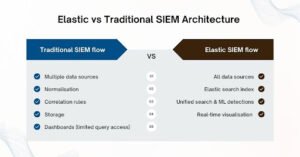
Elastic SIEM didn’t start as a compliance tool wrapped in dashboards. It evolved from Elasticsearch, an open-source engine built to handle large-scale data indexing and querying. Security teams were already using it informally for log analysis long before Elastic formalised its SIEM offering. That foundation changed the dynamics entirely. Instead of building from a security product mindset—limited fields, rigid correlation rules and costly scaling—Elastic SIEM was built on a search-first foundation.
That means analysts can ingest practically any data source. Endpoint telemetry, VPC flow logs, DNS data, container metrics, even application traces. The stack doesn’t impose an arbitrary boundary between “security data” and “operational data.” Everything is searchable. And that distinction is at the heart of why people are choosing Elastic SIEM over traditional SIEM tools across industries.
Security investigations aren’t neat or linear. They start with a vague indicator—a process hash, an IP or a behaviour pattern—and spiral outward into context. Elastic SIEM fits that investigative rhythm because it’s built on fast, flexible search. Traditional SIEMs, designed around pre-defined use cases, often struggle to accommodate this fluid exploration. They want structure where analysts need freedom.
The Cost of Traditional SIEM Thinking
For many teams, the breaking point isn’t functionality, it’s economics. Traditional SIEM licensing models are widely restrictive. Vendors charge by data volume, ingestion rate or node count. The logic made sense a decade ago, when log data volumes were manageable. It doesn’t hold up now. Cloud environments, containerised applications and microservices architectures generate data at scales that traditional SIEMs were never designed to handle affordably.
This cost model has unintended consequences. Security teams end up rationing their data. They choose not to forward full audit logs or omit debug-level telemetry because it pushes them over a pricing threshold. As a result, investigations start with incomplete visibility. Missing logs lead to missed detections. By contrast, Elastic SIEM’s open licensing and scalable architecture make it possible to keep full telemetry data accessible without financial strain.
It’s not just about saving money—it’s about removing friction from investigation. The ability to query across years of data without wondering how much it will cost, changes how analysts work. It encourages curiosity. It makes threat hunting practical rather than aspirational.
Flexibility Over Formula
The traditional SIEM model depends heavily on static correlation rules. These rules were built for environments where threat patterns evolved slowly. But adversaries now move faster than signature-based detections can adapt. Elastic SIEM introduces flexibility at this layer. Its rules and detection logic are written as code, stored in Git and version-controlled. Teams can customise detections, deploy new ones and collaborate through open repositories.
Elastic’s detection engine also integrates machine learning natively, but not as a black box. It is transparent i.e. teams can inspect the models, understand their baselines and retrain them against their own data. This transparency is what separates Elastic from many traditional tools that promise “AI-powered” detections yet reveal little about how decisions are made. Analysts regain trust in the system because they can see, tweak, and own its logic.
That ownership is cultural as much as technical. Security teams using Elastic SIEM often operate closer to a DevSecOps mindset. They write their own detections, automate response workflows, and treat the SIEM as part of their engineering fabric, not a separate compliance console. This freedom reduces dependency on vendor support cycles. When a new threat vector emerges, they can respond in hours and not wait for a quarterly content pack.
The Search-Centric Approach to Visibility
Elastic SIEM’s greatest strength lies in how it treats search as the centre of the experience. Analysts can move fluidly from high-level dashboards into raw data with a single query. No context switching, no waiting on exports, no limitations on fields. The workflow feels investigative rather than administrative.
This matters because most modern incidents don’t follow predictable patterns. A credential misuse might link to an unexpected cloud API call, which then ties back to an anomalous process on a container host. Traditional SIEMs struggle with this chain of reasoning because they separate data into categories—endpoint data in one module, cloud data in another, network data elsewhere. Elastic collapses that separation. Everything lives in one searchable universe.
Performance reinforces that experience. Elasticsearch was built for speed at scale. Query latency stays low even when datasets grow into terabytes. Analysts can pull six months of process creation logs instantly, filter by hostname and pivot to network flow data without re-indexing. The difference in workflow speed translates directly to faster mean time to detect (MTTD) and mean time to respond (MTTR).
Control Without Constraint
Elastic SIEM’s appeal also lies in control. Teams can deploy it on-premise, in private cloud or within elastic cloud’s managed service. They decide how data is ingested, where it’s stored and how long it’s retained. There are no hidden retention limits or opaque data pipelines. This transparency aligns well with regulatory expectations, where data sovereignty and auditability matter as much as detection capability.
Traditional SIEM vendors often gatekeep integrations and analytics features. Elastic’s open architecture does the opposite. It integrates with open standards like STIX, TAXII, and Sigma. It supports external threat feeds and orchestration platforms without vendor lock-in. That flexibility turns Elastic SIEM into an ecosystem component rather than a monolithic solution.
It’s not uncommon to see organisations running Elastic SIEM alongside tools like Zeek, Suricata or MISP. Each serves a specific role, feeding data into Elastic’s unified view. The result is an investigative environment tailored to the organisation, not a one-size-fits-all platform shaped by vendor assumptions.
A Shift in Mindset, Not Just Tooling
The adoption of Elastic SIEM isn’t simply a technology upgrade. It reflects a change in how security operations view their mission. Instead of buying more automation to keep up with alerts, teams are rediscovering the value of asking better questions. Search-driven investigation fosters that habit. It encourages pattern recognition, hypothesis testing, and human insight.
Some SOC leaders describe this shift as “getting back control of the narrative.” With traditional SIEMs, they felt boxed in by dashboards and vendor-defined workflows. With Elastic, they feel closer to the raw story the data tells. That distinction is subtle but significant. It reintroduces curiosity into analysis – a quality automation alone can’t replace.
Elastic’s community-driven nature also helps sustain that mindset. Detection rules, dashboards and threat hunting templates are shared openly. Lessons from one organisation often become baselines for another. This collaborative approach mirrors how threat actors evolve – fast, decentralised and adaptive. Security teams finally have a framework that moves at a similar pace.
Not a Silver Bullet, but a Better Foundation
Elastic SIEM isn’t perfect. Its flexibility comes with a learning curve. Teams without experience managing Elasticsearch clusters may face tuning challenges early on. Query design, index lifecycle management and capacity planning still require skill. But these are operational challenges, not structural flaws. They can be solved through good engineering practice.
Traditional SIEMs, in contrast, face deeper structural limits. They can’t easily scale horizontally, and their pricing discourages full visibility. As long as those issues remain, Elastic SIEM’s appeal will continue to grow.
The Direction of Travel
Security teams are pragmatic by nature. They don’t adopt new tools lightly. The movement toward Elastic SIEM is not driven by hype or brand loyalty, but by necessity. The scale of modern data demands systems that are open, flexible and fast. The closed architectures of traditional SIEMs simply don’t meet that demand anymore.
What’s changing is not the idea of a SIEM, it’s the definition of what an SIEM should be capable of. Elastic SIEM embodies that redefinition: visibility without restriction, analysis without waiting and collaboration without barriers.
The result isn’t just faster detection. It’s a security culture that values exploration over automation fatigue. A culture where teams can see more, understand more, and act sooner. And in that sense, choosing Elastic SIEM over traditional SIEM tools is less about switching vendors, and more about choosing a way of working that finally keeps pace with the threats themselves.
Conclusion
If your organisation is thinking about choosing Elastic SIEM over traditional SIEM tools, you should start by looking at your current problems like cost, scalability, detection latency, analyst efficiency. Knowing what legacy SIEM platforms fall short can help you decide if Elastic SIEM is the right move for your business.
CyberNX is a cybersecurity firm that can help your business develop and implement Elastic SIEM according to best practices on elastic cloud, on-premises, or public cloud to meet your business requirements.
The decision is ultimately about resilience. Security teams that align SIEM strategy with how attacks actually happen – and how infrastructure actually behaves – will be far better prepared to detect, respond and recover in an increasingly complex threat landscape.