
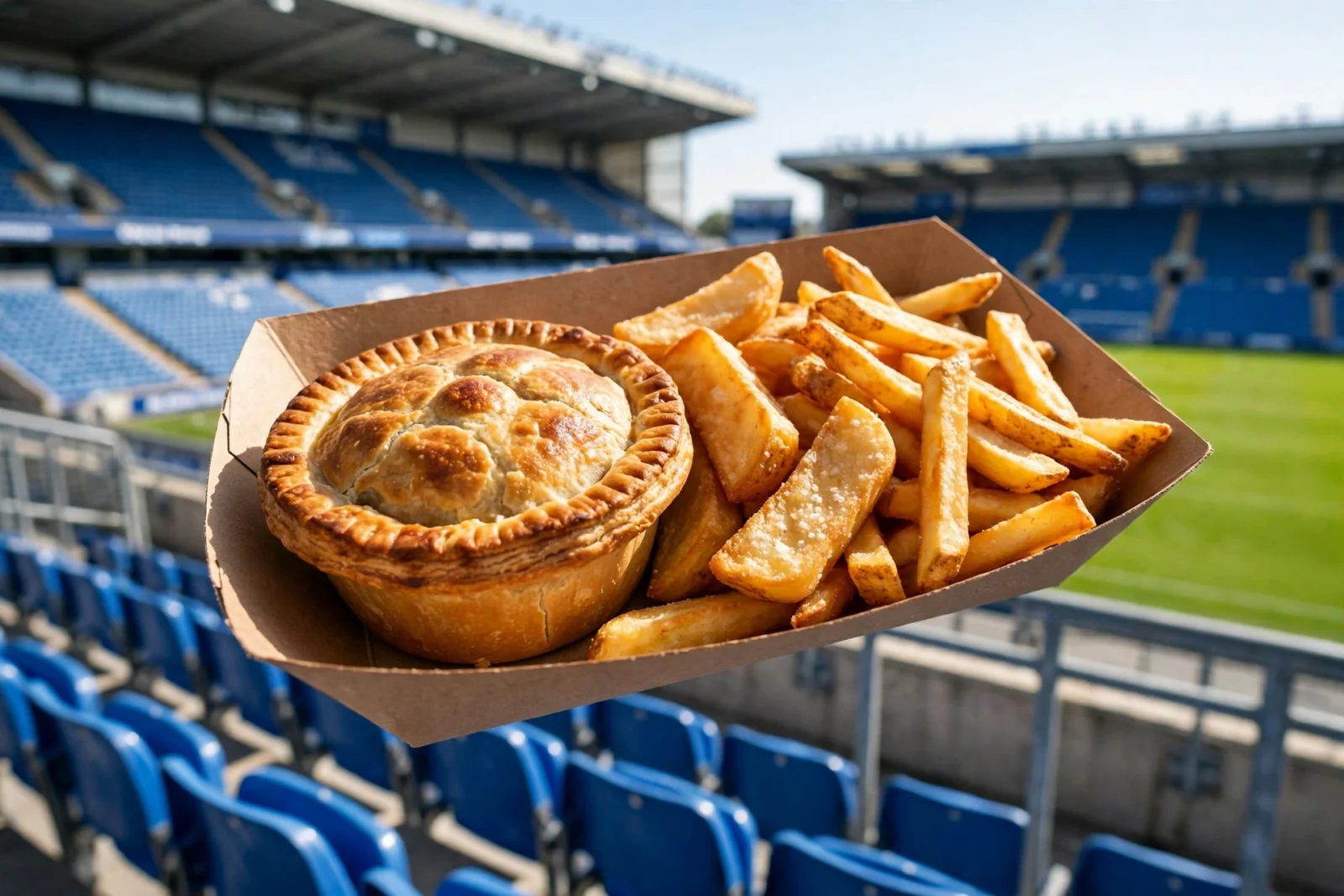
Scrandle is a small daily game with a simple question at its heart. Two dishes from real football stadiums appear side by side, and you have to guess which one the crowd liked more. That is all there is to it, and that is exactly why it works.
There is no long tutorial, no account to create before your first round, and no skill to learn in advance. You open the game in your browser, look at two photographs of matchday food, and make a call. Sometimes the answer is obvious: a hot, generous burger next to a sad, grey pie is not much of a contest. Sometimes it is not obvious at all. A strange local speciality can beat a familiar favourite, because the crowd voted for it, and the crowd does not always vote the way you expect. That gap, between what you would order and what thousands of other people actually liked, is what Scrandle is built on.
Quick Facts: Scrandle
- What it is: A free daily online guessing game about football stadium food
- Name origin: “Scran” (British slang for food) + Wordle
- How it works: Two real stadium dishes are shown; guess which one fans rated higher
- Rounds per day: Ten head-to-head rounds, according to daily answer guides
- Ratings source: Polls from the @FootyScran account on X (Twitter)
- Cost: Free in a browser, no download required
- Account needed: No account required for the basic daily game
- Creator: Dan Boland, who first wrote the game for a friend
- Data set: More than 2,000 food items, according to the creator
- First released: Reported as 2023 by some sites; other sites say 2024 – not confirmed
What Is Scrandle?
It is a daily online game in which players compare two foods served at football stadiums and guess which one received the higher rating from fans. Each dish comes with a real photograph, usually taken by a fan at the ground, along with its price and the club or stadium it came from.
The twist is important. You are not asked which dish you like best. You are asked which dish the crowd liked best. A dish can win in Scrandle even if you would never order it, and a dish you love can lose if the wider crowd was not impressed. That is what makes the game feel different from a normal food quiz. It is a test of how well you can read other people, not just your own appetite. The game is free, it runs in a web browser, and it takes only a few minutes to play, with one main daily challenge in the same spirit as Wordle.
Where the Name Scrandle Comes From
The name Scrandle is a blend of two words. The first is “scran”, a British slang word for food, used a lot in football culture to talk about what is on sale at a ground. A “footy scran” is a matchday meal, from a meat pie to a box of loaded fries. The second is Wordle, the daily word game that made the one-puzzle-a-day format famous.
Put them together and you get the idea in a single word: a daily guessing game about scran. It is not a Wordle clone in the sense of guessing letters. It borrows the daily rhythm instead. One game a day, shared by everyone who plays it, with a result you can compare with friends and a streak you can try to keep alive.
How to Play Scrandle
Playing is straightforward. You open the website, and the first matchup is already waiting. No download is needed, and no sign-up is required to start the basic daily game. Each round shows two stadium dishes, each with a photograph, a name, a price, and the club, stadium, or country it came from. You pick the one you think fans rated higher, and the game reveals the real rating for each dish, usually as a percentage.
You work through the day’s rounds in the same way. Daily answer guides describe it as ten head-to-head rounds a day, with a perfect game meaning you got all ten right. Some versions also offer extra modes, such as a random mode or a history mode, but the daily game is the heart of it. There is no timer pushing you to rush, and no penalty for thinking about a matchup for a while.
How the Ratings in Scrandle Work
The most interesting part of the game is where the numbers come from. The dishes are not made up, and their ratings are not invented by the game itself. They come from real posts by the @FootyScran account on X, formerly Twitter, where fans share photographs of the food they have bought at football grounds and other fans vote on it.
The creator, Dan Boland, has explained the system in his own writing. Each food item has a poll attached to it, asking “Scran” or “No Scran”. The percentage who voted “Scran” is the rating that is compared. When two dishes face each other, the one with the higher “Scran” percentage wins. A round is not a record of a head-to-head poll between those two exact dishes. With more than 2,000 items in the data set, that would mean millions of separate polls, which never happened. Instead, each dish brings its own earlier poll result with it, and the game compares those two numbers.
What a Typical Day of Scrandle Looks Like
A typical day starts the same way for everyone. Ten matchups appear, each one a pair of real stadium foods from somewhere in the world. One day might open with a beef chilli con carne from England against a corn dog from the United States. The next might put a chicken tikka wrap against a toffee apple crumble.
The dishes come from clubs at every level. It covers Premier League sides such as Arsenal and Liverpool, lower-league clubs such as FC United of Manchester, MLS teams such as LAFC, and South American clubs such as Cruzeiro. The daily generator tries to keep the game balanced. According to the creator, a normal day aims for roughly three easy matchups, four medium ones, and three hard ones, with the order shuffled. Fridays are different: they are themed and curated, and the creator increasingly hand-picks each Friday matchup himself.
Why Scrandle Became So Popular
The game did not start as a big commercial project. According to its creator, Dan Boland, it started as a game he wrote for a friend. It later became a game called SCRAN GAME, released on the itch platform under a pseudonym, and then grew into the browser game people play today. He put it on a domain, added no analytics, and forgot about it for a while. Then people found it. A small group of streamers picked it up, including Northernlion, Joseph Anderson, and AvoidingThePuddle, and the creator has said it reached around 100,000 players without him really trying to promote it.
Part of the appeal is the format. Daily games are easy to fit into a routine. You play once, you talk about it, and you come back tomorrow. Part of the appeal is the subject. Football stadium food is a topic fans already argue about. Every supporter has an opinion about the pie at their ground or the price of a burger. The game takes that everyday argument and turns it into a game, with real photographs and real votes to settle it. And part of the appeal is the humour. Some dishes are genuinely appetising. Others are gloriously strange, and it puts them front and centre and asks you to judge them fairly.
Evil Mode and Scrandle 2
The game has not stayed exactly the same since it first appeared. One well-known addition is Evil Mode. In Evil Mode, the photographs are turned to grayscale, so you cannot use colour to judge a dish. Your performance in Evil Mode is tracked separately, so you can see how much you were relying on colour without realising it.
There is also a second version in development. The creator has said he has completely rewritten the game client to make it easier to add new gimmicks, and he is building a dynamic rating system. In that system, dishes with no Twitter poll could still be rated, based on the decisions Scrandle players themselves make. The creator is honest about the risk: the ratings would no longer be a record of what random football fans voted for, but a record of what Scrandle players chose, which is a different thing.
Is Scrandle Free, and Is It Safe?
It is free to play. It runs in your browser, with no download, no install, and no payment required for the daily game. Some versions offer an optional free profile, so you can sync a streak across devices or appear on a leaderboard, but anonymous play works without one. There are no hidden costs in the basic game.
That does not mean every site with the game’s name in its address is the same game. Because the idea is simple and the name is catchy, copycat sites have appeared, some offering a word-puzzle game instead of the stadium-food game. The original game, as described by its creator and by the daily answer guides, is the stadium-food comparison game built from @FootyScran posts. As for safety, a browser game with no account needed keeps the risk low. You are not handing over personal details to play, and you are not downloading software. For a wider look at how daily puzzle games became a shared habit, Wikipedia has useful background on Wordle and the daily-game format.
Tips for Playing Scrandle Well
The game rewards thinking like the crowd, not thinking like a food critic. The winner is the dish other people rated higher, not the dish you would personally order. You might love a spicy, unusual dish, but if the crowd found it off-putting, it will lose. You might find a plain cheeseburger boring, but if thousands of fans gave it a high rating, it will win.
Familiar comfort food travels well here. Burgers, loaded fries, pizza, and well-made pies tend to do well, because most people understand them at a glance. Judge the photograph, not just the name. A plain-sounding dish can win on presentation, with neat packaging and generous portions. An exciting name can hide a sad plate, with cold chips or a squashed bun. The price is a clue, too: a dish that looks generous for its price often scores better than one that looks expensive for what you get. And do not be too upset by a wrong answer. Scrandle is designed to surprise you.
Common Confusions About Scrandle
Because the name is unusual, there are a few confusions worth clearing up. The first is the idea that it is a breakfast dish, a kind of scrambled eggs with extra ingredients. That definition appears on some low-quality websites, but there is no reliable source behind it, and it does not match the game most people mean. It looks like an invented explanation for a made-up word.
The second confusion is the idea that the word means gossip, rumours, and controversy on social media. Some articles use the word in that sense, but there is no solid evidence that this is an established meaning. It reads like content written around a keyword, rather than a description of something people actually say.
The third confusion is with other games that share the name. A word-puzzle game exists on some sites, where you unscramble letters to form words. That is a different game, using the same name for a different idea. Finally, the launch date is unsettled. Some game sites say it launched in 2023, others say 2024, and the creator’s own writing does not give a single clear launch year in the material checked for this article. This article therefore does not state a launch year as a settled fact. What is clear is that it was already being played and written about by 2025, when the creator published his detailed account of how it works.
Frequently Asked Questions About Scrandle
What is Scrandle?
Scrandle is a free daily online game about football stadium food. Each day, two real dishes from real football grounds are shown side by side, with photographs, prices, and the club or stadium they came from, and the player guesses which one fans rated higher. The name comes from “scran”, British slang for food, and Wordle.
How do you play Scrandle?
You open the game in your browser and look at the first matchup of the day. Two stadium dishes appear, each with a photograph, a name, a price, and its origin. You pick the one you think fans rated higher, and the game reveals the real rating for each dish. You work through the day’s rounds the same way, and a new daily game arrives the next day.
How many rounds are there in Scrandle each day?
Daily answer guides describe it as ten head-to-head rounds a day, with a perfect game meaning you got all ten right. The creator has said the daily generator aims for roughly three easy matchups, four medium ones, and three hard ones, with the order shuffled.
Where do Scrandle ratings come from?
The ratings come from the @FootyScran account on X, formerly Twitter, where fans share photographs of stadium food and vote on it. Each dish has a poll asking “Scran” or “No Scran”, and the percentage who voted “Scran” is the rating compared. The game is not affiliated with @FootyScran or with any football club.
Is Scrandle free?
Yes, it is free to play in a browser, with no download and no payment required for the daily game. No account is required to play the basic game, although some versions offer an optional free profile to sync a streak or appear on a leaderboard.
Who made Scrandle?
It was made by Dan Boland, who first wrote it as a game for a friend. It later became a game called SCRAN GAME on the itch platform, and then grew into the browser game played today. He has written openly about how it works, including the size of the data set and his plans for a second version.
Conclusion
It is a reminder that a good game does not need to be complicated. Two photographs, one question, and a daily reason to come back are enough. It takes a subject football fans already care about, the food at their ground, and turns it into a shared daily ritual, with real photographs, real votes, and real surprises.
It works because it is honest about what it is. It does not pretend the ratings are a scientific measure of taste. They are a record of what a crowd of fans thought, on a particular day, about a particular plate of food. If you have never played it, the best way to understand it is to play one day of it. Look at the two dishes, make your pick, and see whether the crowd agreed with you. You will probably get some right and some wrong, and the wrong ones will be the ones you remember.
You can find more stories like this one on the Night Times homepage where new guides and features are published regularly.