
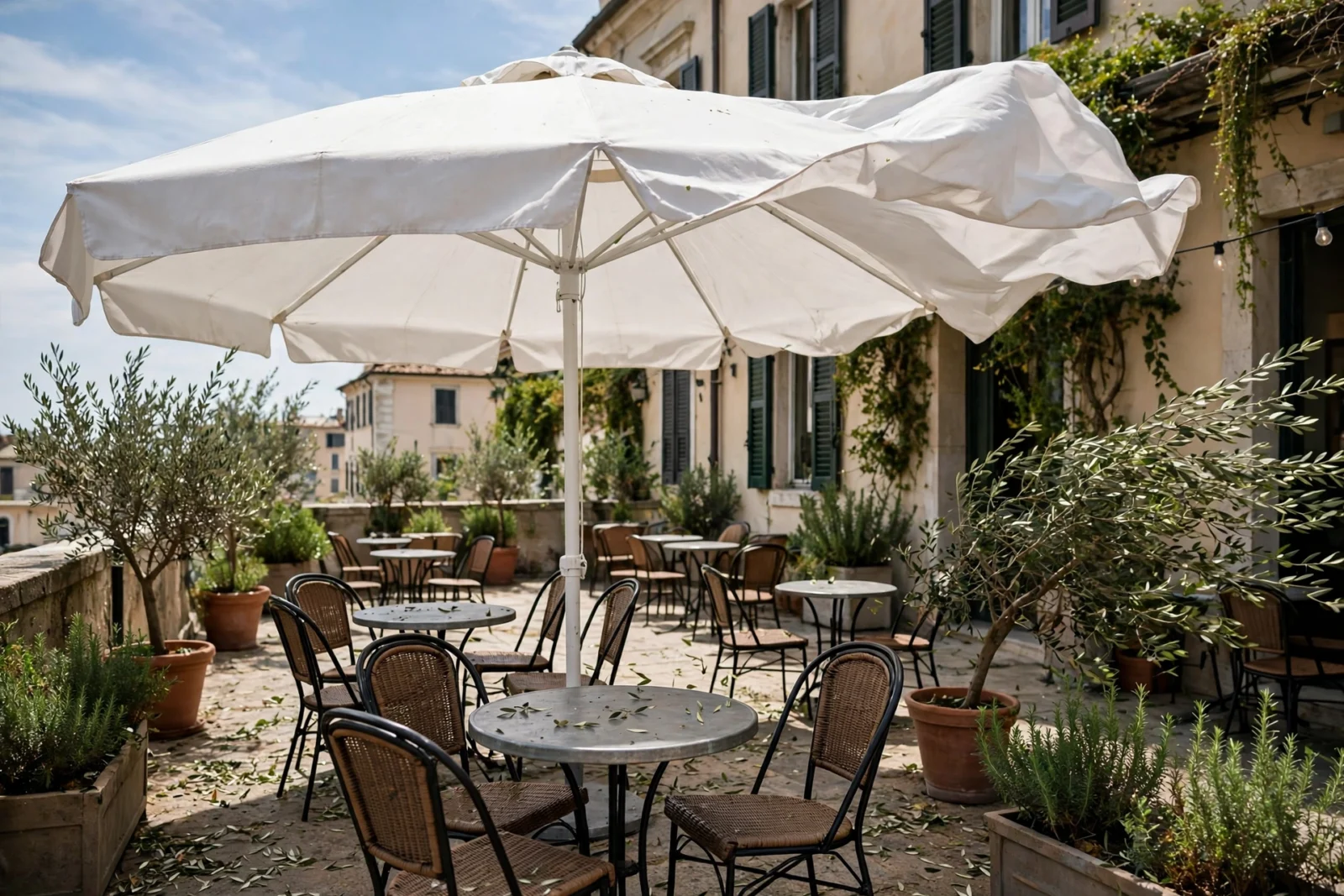
Most umbrellas fail in exactly the same way. A gust catches the canopy, the ribs bend the wrong way, and a moment later you are holding a broken frame and wondering why you bought it. Anyone who has eaten outside in Australia knows that story well, because the wind there does not arrive politely. It comes off the coast, changes direction without warning, and can turn a cheap umbrella into a hazard in seconds.
Ausbrella was made for that problem. It is a premium commercial umbrella range from Awnet, a Melbourne manufacturer, and it is sold on a bold claim: that it is the world’s strongest umbrella. This article looks at that claim carefully. It explains what Ausbrella actually is, how it is built, what the wind ratings mean, where it is used, and what it costs to buy and look after.
Quick Facts: Ausbrella
Full name: Ausbrella
What it is: Premium commercial market umbrella range
Maker: Awnet, Melbourne, Australia
Maker founded: 1980, family owned and operated
Maker address: 158-166 Williams Road, Dandenong South, Victoria 3175, Australia
Main claim: Described by Awnet as the world’s strongest umbrella
Top wind rating: Hurricane 160+ model, wind-tunnel tested to over 160 km/h
Other model: Storm 135, rated to 135 km/h on Awnet’s current product page
Key design: Twin-skin pole, patented, with eight radial arms and an interlock system
Testing: Wind-tunnel tested at Monash University; engineer certified
Canopy: Acrylic canvas, solution-dyed, water-resistant and rot-resistant, UPF 50+
Shapes: Square or octagonal
Warranty: 5 years on frame and acrylic canvas cover, per Awnet listings
Best for: Resorts, cafes, restaurants, hotels, pools, councils and public spaces
Price indication: HospitalityHub lists an Ausbrella product at 850 AUD, as a guide only
What Is Ausbrella?
Ausbrella is not a small hand-held umbrella, and it is not a garden umbrella from a hardware store. It is a large, fixed market umbrella, the kind you see over a cafe table, beside a resort pool, or in a council park. Awnet, the company behind it, has made market umbrellas and cafe barriers in Australia for more than forty years, since 1980. The company is family owned and operated, based in Melbourne, and it describes its products as Australian designed, engineered and made.
The name itself gives the game away. Ausbrella is a blend of Australia and umbrella, and the product is shaped by Australian conditions. Australia has some of the highest levels of ultraviolet radiation in the world, long hot summers, and coastal winds that can arrive suddenly. A shade umbrella that works in a sheltered European courtyard can fail quickly on an open Australian beachfront. Awnet’s answer was to build an umbrella that treats wind as the main problem, not an afterthought.
Why Ordinary Umbrellas Fail in Wind
To understand Ausbrella, it helps to understand why a normal umbrella gives up so easily. A standard umbrella works like a parachute. The canopy catches the wind, the wind pushes up from underneath, and the force travels straight into the ribs and the pole. The ribs are thin, the pole is often hollow and light, and the base is often too small for the canopy. Once the wind is strong enough, something has to give, and it is usually a rib, a joint, or the whole umbrella lifting out of its base.
The other problem is the flip. When a gust hits from the side, the canopy can invert, turning inside out in a second. That is not just annoying. A flipped umbrella has sharp rib ends pointing outwards, and a canopy flapping in the wind is hard to control. In a crowded outdoor area, that is a safety issue. An Ausbrella is designed to handle those forces differently, with a heavier, stronger frame, a pole with an extra inner skin, and a canopy that is fixed firmly to the frame. The aim is not to make the umbrella impossible to damage in any weather, because no outdoor umbrella can promise that. The aim is to raise the point at which it fails, so that it stays standing in winds that would destroy a normal market umbrella.
The Twin-Skin Pole and the Frame
The best-known part of an Ausbrella is its pole. Awnet calls it a twin-skin pole, and it is the centre of the design. In simple terms, the pole has an extra inner lining, so it is effectively a pole inside a pole. That gives it much more strength without making it so heavy that it cannot be handled. Awnet links the design to Australian patent number 2014200765, and describes the twin-skin pole as patented.
Around that pole sit eight radial arms, the ribs that hold the canopy open. Awnet says those arms use a design-registered interlock system, which locks them together in a way that spreads the load across the frame rather than leaving one joint to take the full force. The Hurricane model goes further, with an additional outer pole that makes it stronger than the Storm model. The frame is aluminium, with stainless steel fittings, and the opening system works without ropes or pulleys, which are a common weak point on cheaper umbrellas. The base matters just as much. An Ausbrella is made to sit in a matching in-ground stainless steel socket, which holds it firmly in the ground, rather than in a light portable base that can slide or tip.
Wind Ratings: Storm and Hurricane
Wind ratings are where an Ausbrella needs careful reading, because the numbers have changed over time and different sources give different figures. The current picture, from Awnet’s own product pages, is straightforward enough. The Hurricane 160+ is the top model. Awnet says it is wind-tunnel tested to winds in excess of 160 km/h, and HospitalityHub gives the same figure. Awnet also says the Hurricane was tested at Monash University, in the university’s wind tunnel facility, and that it is fully engineer certified, by Don Moore and Associates. That testing is the backbone of the world’s strongest umbrella claim. It is not a guess from a brochure. It is a measured result from a university wind tunnel.
The Storm model is rated lower. Awnet’s current Storm 135 product page gives a wind rating of 135 km/h, with a five-year warranty on the frame and acrylic canvas cover. Other pages give different Storm figures, including 140 km/h, and an older press report describes a Storm 120, a Hurricane 135 and a Cyclone 160+ range. Those older names do not match the current Storm and Hurricane range, so readers should treat the current Awnet product pages as the best guide.
The Canopy and the Shapes
A strong frame is only half of an umbrella. The canopy has to survive sun, rain and salt air, and it has to keep its colour and its shape. An Ausbrella canopy is made from acrylic canvas, which is solution-dyed, meaning the colour is built into the fibre rather than printed on the surface. That helps it resist fading, even after long exposure to strong sun. Awnet describes the canopy as water-resistant and rot-resistant, with a UPF rating of 50+. UPF measures how much ultraviolet radiation a fabric blocks, and a UPF 50+ fabric blocks almost all UV rays, which matters in Australia, where sun protection is a daily concern. The canopy is also bolted on, rather than tied or clipped loosely, which gives it greater security in wind.
Ausbrella comes in square or octagonal shapes. The square shape suits a table for four, or a seating area that needs to cover a defined space. The octagonal shape suits a round table, or a space where people move around the umbrella from all sides. Awnet does not give a single standard size on its main listings, and secondary guides give a wide span, from about 10 to 20 feet wide, so buyers need to check the size for the model they are considering.
How Much Does an Ausbrella Cost?
Price is the hardest part of the Ausbrella story to pin down, because Awnet sells through quotes rather than a single fixed price list. The price depends on the model, the size, the shape, the canopy colour, the base or socket, and whether the umbrella is for a single site or a larger commercial order. The best public guide is HospitalityHub, which lists an Ausbrella commercial umbrella at 850 AUD, and gives a general range for commercial umbrellas of 200 to 1,500 AUD, averaging 850 AUD. That figure should be read as an indication, not as a firm price. A Hurricane 160+ in a large size, with an in-ground socket and installation, is likely to cost more than a smaller Storm model.
The more useful question is cost per year, rather than cost on the day. A cheap umbrella that costs 100 AUD and lasts one season costs 100 AUD a year, plus the time spent replacing it and the risk that it fails in wind. An Ausbrella that costs several times more but lasts for many years, with a five-year warranty on the frame and canvas, can work out cheaper over its life. That is the argument Awnet makes, with its motto of buy it once and enjoy it forever, and it is a fair way to think about a commercial purchase, as long as the buyer checks the warranty terms for the exact model they are buying.
Choosing, Installing and Caring for an Ausbrella
Choosing an Ausbrella starts with the wind, not with the colour. The first question is where the umbrella will stand, and how exposed that spot is. An open beachfront, a rooftop terrace, or a poolside area with no windbreak will see stronger gusts than a sheltered courtyard. Awnet provides a wind region and terrain guide to help buyers match the model to the site, and that guide is worth using before any other decision. The second question is size and shape. Measure the table or seating area, add room for people to move, and check how much shade the umbrella will cast. Both shapes need a base or socket strong enough for the canopy size, and the in-ground socket is the safest option for a fixed commercial site.
Installation should not be casual. The in-ground stainless steel socket needs to be set correctly, the pole needs to be seated firmly, and the canopy needs to be bolted on as designed. Once it is installed, care is straightforward. The canopy should be kept clean and allowed to dry before it is closed for a long period, so that mould does not grow in the folds. The five-year warranty is a useful safety net, but it is not a substitute for care, and it covers defects, not damage from misuse, poor installation, or a storm beyond the rated wind speed.
Common Confusions and What Is Not Verified
Because Ausbrella is sold through resellers and written about in many secondary guides, confusion has built up around it. The first confusion is about the model names and wind ratings. Older reports list a Storm 120, a Hurricane 135 and a Cyclone 160+, while current Awnet pages list a Storm 135 and a Hurricane 160+. Those are not the same range, and the older figures should not be used as the current specification. The second confusion is about the warranty. HospitalityHub and Awnet both give a five-year warranty on the frame and acrylic canvas cover. Some secondary guides give much longer warranties, including fifteen years on the frame and ten years on the fabric. Those longer figures do not match the current five-year warranty, so they should be treated as unverified or out of date.
The third confusion is about materials. A secondary guide claims marine-grade aluminium with tensile strength over 300 MPa, high-density acrylics at around 300 GSM, and compliance with AS/NZS 1170 for wind loads up to 50 metres per second. Those figures do not appear on Awnet’s current product pages, and the guide itself is a guest post rather than a maker specification. This article does not present those figures as verified facts. Finally, Ausbrella is sometimes confused with other umbrellas that use similar names or claims. It is a specific range from Awnet, and an umbrella that claims a similar wind rating without Monash wind-tunnel testing or engineer certification is not the same product.
Frequently Asked Questions About Ausbrella
What is Ausbrella?
Ausbrella is a premium commercial market umbrella range made by Awnet in Melbourne, Australia. It is designed for resorts, cafes, restaurants, hotels, pools and public spaces, and it is described by Awnet as the world’s strongest umbrella, with its top model wind-tunnel tested to over 160 km/h.
Who makes Ausbrella?
Ausbrella is made by Awnet, a family-owned Australian company established in 1980 and based at Dandenong South, Melbourne. Awnet is also a leading maker of market umbrellas and cafe barriers in Australia, and it is a division of Asigns Pty Ltd.
How strong is an Ausbrella?
The Hurricane 160+ model is wind-tunnel tested to over 160 km/h, at Monash University, and is engineer certified. The Storm 135 model is rated to 135 km/h on Awnet’s current product page. Those ratings apply under controlled test conditions and with proper installation, not as a promise that the umbrella is indestructible in any storm.
What is the twin-skin pole?
The twin-skin pole is the central pole of an Ausbrella, with an extra inner lining that gives it much more strength without making it excessively heavy. Awnet links it to Australian patent number 2014200765. The Hurricane model adds an outer pole for even more strength.
What is the Ausbrella canopy made from?
The canopy is acrylic canvas, solution-dyed for fade resistance, water-resistant and rot-resistant, with a UPF rating of 50+. It is bolted on for greater security in wind, and it comes in square or octagonal shapes.
How long does an Ausbrella last?
Awnet gives a five-year warranty on the frame and acrylic canvas cover. With proper installation and care, the umbrella is meant to last for many years, but longer life figures given in secondary guides, such as fifteen years, are not stated on Awnet’s current product pages and should be treated as unverified.
How much does an Ausbrella cost?
There is no single fixed price. HospitalityHub lists an Ausbrella product at 850 AUD, as a guide, and gives a general range for commercial umbrellas of 200 to 1,500 AUD. The actual price depends on the model, size, shape, canopy and installation, and is usually given by quote.
Where can an Ausbrella be used?
Ausbrella is best suited to fixed commercial settings, including resorts, cafes, restaurants, hotels, pools, councils, schools and public areas. It is made to sit in an in-ground stainless steel socket, and it is designed for Australian wind regions and terrain, with a wind region guide to help buyers choose the right model.
Conclusion
Ausbrella is a good example of a product that was made for a real place and a real problem. Australia’s sun is strong, its winds are sudden, and its outdoor spaces are busy. A normal umbrella fails in those conditions, and a failed umbrella in a cafe or a resort is a safety risk, not just a broken purchase. Awnet’s answer was to build a heavier, stronger umbrella, with a twin-skin pole, eight interlocking arms, a bolt-on acrylic canopy, and a proper in-ground socket, and then to test it in a university wind tunnel until it stayed standing at over 160 km/h.
That testing is what sets Ausbrella apart, and it is also what buyers should focus on. The world’s strongest umbrella is a bold claim, and it should be read with the model, the installation and the conditions in mind. You can find more guides like this one on the homepage of The Night Times where new features are published regularly, and for general background on how umbrellas and shade structures work, Wikipedia is a useful starting point.