
Sruhl is a word that stops most readers in their tracks. It looks like a name, it sounds like a place, and it could easily be a surname, a brand or a website. The honest answer is that it has no single, settled meaning in the real world, and anyone who gives you one without a warning is guessing.
If you typed it into a search engine, you probably met it in one place first: a fantasy story. In the Royal Road web novel Sky Dungeon, a Sruhl is a strange, horned beast, and a whole mountain range is shaped like one. That is the only meaning with a clear, checkable description behind it. Everything else in the search results is a near-miss – a surname spelled Ruhl, an Irish place name spelled Shrule, or a different word that only looks similar at a glance.
This article gives you the verified meaning first, walks through the world built around it, and then separates the look-alikes, so you can tell in a few seconds which one you actually meant.
Quick Facts: Sruhl
Best-known meaning: A fictional creature in the web novel Sky Dungeon
Creature described as: Like a water buffalo, with a tail fin instead of a buffalo tail and a single horn on its head
Also the name of: A mountain range shaped like the creature, in the same story
Country in the story: Ocrium, which spans the whole mountain range
Capital city: Lario, at the base of the most magic-rich mountain
Mountains in the range: 11 mountains, with one major city at the base of each
First clear appearance: Chapter 5 of Sky Dungeon, “An Unexpected Visitor”, on Royal Road
Real-world person, company or website: None verified
Often confused with: Ruhl (a German surname), Shrule / Sruthair (Irish for “stream”), Shrull and Slurm
What Is Sruhl? The Straight Answer
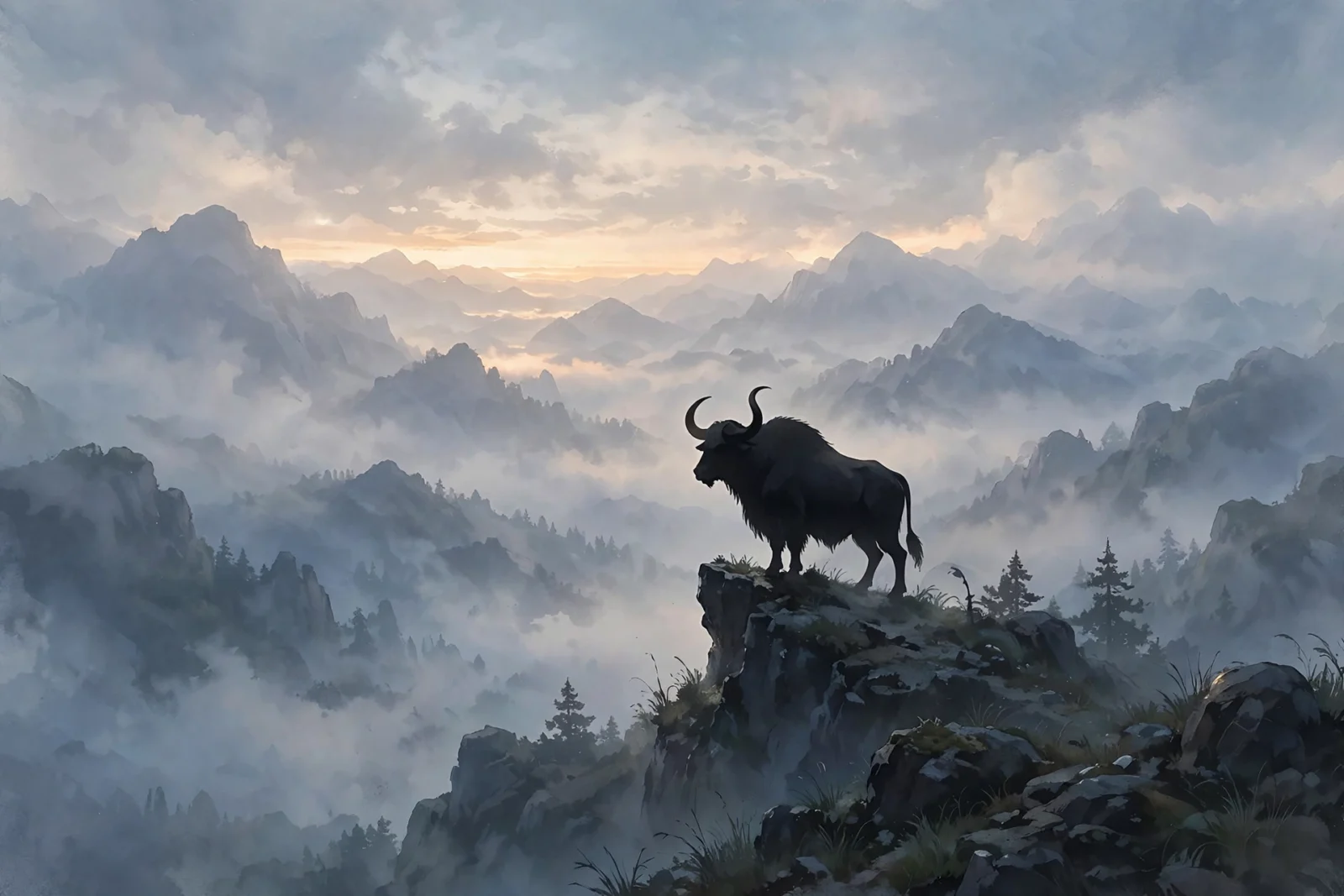
Sruhl is, first and foremost, a creature from a work of fiction. In Sky Dungeon, the main character, Hebe, recognises a mountain range from her foreign memories and names the beast it resembles. The story gives the creature in one short, vivid sentence: a Sruhl looked like a water buffalo but with a tail fin instead of a buffalo tail and a single horn growing from their head.
That is almost everything the story says about the animal itself, and it is worth pausing on. The beast is not described as a pet, a mount or a monster to be fought. It is a shape in the reader’s mind, an amphibious beast of burden, part land animal and part water creature, with one horn where a buffalo would have two. The tail fin is the detail that makes it strange. A water buffalo belongs on muddy ground. A tail fin belongs in water. Put them together and you get a creature that seems built for both, which fits a world where magic, rather than biology, sets the rules.
The second thing the story does with the word is bigger. It turns the creature into a landscape. The mountain range Hebe sees is shaped like the beast lying down, and the tallest point in the range is its horn. That is why the range matters, and why readers remember the name long after they have forgotten the exact sentence. Here the word is not just an animal. It is the map.
None of this makes the creature real, and this article will not pretend otherwise. There is no verified animal of this name in zoology, no specimen in a museum collection, and no entry on a wildlife list. If you came here hoping for a real creature, the answer is simple: the one you are looking for lives in a story, and the story is where it should stay.
The Creature in Sky Dungeon
Sky Dungeon is a web novel published on Royal Road, and its central character is Hebe, a dungeon. That sounds odd until you understand the genre. In dungeon stories, the dungeon itself is alive. It has a body, a core, and a will of its own, and it grows by absorbing magic from the world around it. Hebe is such a being, and in the early chapters she is still learning what her body can do.
When Hebe first sees the mountain range, she is flying. Her dungeon body includes a mountain of cloud, and she is looking for a safe place to land. She spots the range close by, and the shape clicks into place in her foreign memories. Hebe is not a local. She carries knowledge from somewhere else, and Sruhl is part of it. She does not need to be told what it is. She recognises it the way you might recognise a horse or a whale from a silhouette alone.
A water buffalo gives you the size, weight and slow, powerful build of a Sruhl. A tail fin takes away the familiar tail and replaces it with something that belongs in a river or a sea. A single horn takes away the paired horns of a buffalo and leaves one point, rising from the head like a unicorn’s, only heavier. Put those three changes together and you have an animal that feels both grounded and impossible, which is exactly what a fantasy creature should feel like.
It is also worth saying what the story does not say about Sruhl. It does not say how big Sruhl is, what Sruhl eats, how long Sruhl lives, or whether people in that world hunt, ride or fear Sruhl. It does not give Sruhl a habitat, a call or a colour. In Chapter 5 it is a memory and a shape, not a specimen. Readers who want more detail will not find it in that chapter, and they should be suspicious of any website that claims to have it. Later chapters keep returning to the Sruhl mountain range, but they do not turn Sruhl into a bestiary entry. It stays, deliberately, at the edge of the picture.
The Mountain Range and the Country of Ocrium
If Sruhl the creature is the first meaning, the Sruhl mountain range is the second, and in the story it is the more important of the two. The Sruhl range is not a backdrop. It is a country.
The country is called Ocrium, and it spans the entirety of the Sruhl range. The range is made up of 11 mountains, and there is one major city at the base of each mountain. That is a neat, memorable geography: eleven peaks, eleven cities, one country stretched across them all. The largest city, and the capital, is Lario, which sits at the base of the most magic-rich mountain in the range. The rest of the range stretches deeper into gradually magic-deficient territory, behind the horn.
Hebe lands on the tallest point of all in the Sruhl range, the tip of the horn. The horn mountain is covered in thick forest that becomes thinner as you climb toward the peak, and at the somewhat flat peak the forest is more or less completely cleared, leaving a large clearing. It is there that Hebe’s mountain of cloud rests, looking like the true pointy tip of the flat mountain top. A green jade staircase wraps around the puffy white cloud and leads up to a grand temple of white quartz that sits on the cloud like a building housing the gods.
Below that peak, life goes on in a much more ordinary way. The mountain village of Wimborne sits in the middle of the horn mountain, and its people live the kind of life that mountain villages live in fantasy stories: small, close-knit, and a little wary of strangers. Most people gather instead in Lario, the capital, or in one of the other cities at the base of the range.
The range is also dangerous. The forest on the horn mountain is full of beasts, especially as you near the top. A local adventurer, Ran Dewbleeder, climbs the mountain every day as a ritual, and on the way he is attacked by a pack of dire wolves the size of gargantuan carriages. He fights them off with a sword strengthened by his internal magic, and he does it casually, as if it were a morning exercise.
The magic of the range matters too. The mountains are not equally magical. The mountain at the base of which Lario stands is the most magic-rich, and the magic falls away as you move deeper into the range, behind the horn. Hebe notices this because her own mana supply rises and falls with the ambient magic around her. When she flies deeper into the range, her available mana drops sharply, from 1,000 spheres to a little over 450, and that loss shapes everything she does next.
Hebe, Ran Dewbleeder and the Peak of the Horn
The Sruhl range becomes a meeting place in Chapter 5, and the meeting is the chapter’s real story. Hebe has just landed her cloud on the horn’s tip. Ran Dewbleeder, a handsome, powerfully built adventurer with blue eyes and odd blue-tinted black hair, is climbing the mountain on his daily trek. He is a Novice warrior, a rank that lets a human summon thousands of kilograms of strength through magic applied inside the body, rather than cast outwards like a mage’s spell. He is also descended from the Dewbleeder clan, one of the rare human families blessed by an element, in his case the element of water, which helps him heal his wounds much faster than a normal warrior.
Ran is not a stranger to the mountain. He hunts a hare on the way up, roasts it for lunch, fights off the dire wolves, and then keeps climbing. He is approaching middle age, kept youthful by his advancement into the Novice realm, and he has no living family left. His closest friend is a little orphan girl called Grace, with cream-white skin, blazing red hair and enchanting green eyes, who lives in the village orphanage and whom Ran is preparing to adopt.
When Ran reaches the clearing at the peak, he finds something that was definitely not there yesterday: a mountain of cloud, a green jade staircase, and a grand temple of white quartz. He thinks, briefly, that he might be hallucinating, or that he ate a bad mushroom. Then he accepts what he sees and climbs the staircase to investigate. That curiosity brings him face to face with Hebe, and with the statue golems she has unwittingly created, and the story turns on that encounter.
The chapter that follows shows the consequences. The Lario Adventurers Guild posts a request on its bulletin board: investigate the mysterious appearance of an unidentified object on the peak of the horn mountain, and find the two missing persons, Grace and Ran Dewbleeder, dead or alive. The request is tagged as a C-ranked mission. The Sruhl range, which began as a shape in Hebe’s memory, has become a place where people go missing, and where a guild sends adventurers to find out why.
Later, in Chapter 8, the Sruhl range returns again, this time as a source of power. As Hebe enters a hibernative state and evolves from a rank 1 Basic dungeon to a rank 2 Simple dungeon, the ambient magic in all of the horn mountain is temporarily drawn toward her cloud and temple to fuel the change. Her whole being is remade, and her eleven statue golems are reborn with stronger foundations. The Sruhl range is, in that chapter, not just a setting. It is fuel.
Why People Search for the Word
If the verified meaning of Sruhl is a fictional creature and a mountain range, why do so many different kinds of results appear when you search for Sruhl? The answer is that this is a rare, short, unusual string of letters, and search engines do their best with it. They pull together everything that looks close, and the reader is left to sort the pile.
Some of those results are people. The most common is the surname Ruhl, which appears in email addresses, staff directories and public records as sruhl, as in sruhl@clemson.edu or sruhl@uw.edu. Those are not people called by this word. They are people called Ruhl whose first initial is S, so their email handle reads sruhl. It is an easy mistake to make, and it is the kind of mistake this article is written to prevent.
Some results are places. Shrule, a village in County Mayo in Ireland, has an old Irish name, Sruthair, meaning a stream or a river, and the name has taken many forms through the centuries, including Sruhir and Shruel. That is close in spelling, and it shares the idea of water, but it is a different word in a different language, and it has nothing to do with the creature in Sky Dungeon.
And some results are simply other words. Shrull is a shrieking, slimy creature from a role-playing game. Slurm is a workload manager for supercomputers, and also a fictional soft drink. SRU is a library search protocol, Search/Retrieve via URL. None of these is the word in question, but a tired reader, or a search engine working quickly, can easily blur them together.
There is one more source of confusion, and it is worth naming honestly. A number of low-quality websites now publish articles with titles like “What It Means and Which One You Mean”, which admit the confusion and then fill the gap with generalities. Those pages are not evidence. They are a sign that the word is being searched, and that content farms have noticed.
The Surname Ruhl, and Shrule in Ireland
The closest real-world relative is the surname Ruhl, and it deserves a short section of its own, because it is the most likely reason a real person would ever type the word.
Ruhl is a German surname, also written Ruhl, and the standard reference works trace it to a pet form of the personal name Rudolf. The Dictionary of American Family Names gives that derivation plainly. Other sources offer a second thread, linking it to Middle High German words for rough or coarse, or for rest and peace. Those explanations do not all agree, and a family historian should treat them as competing theories rather than a single settled answer.
What is not in doubt is that Ruhl is a real, established surname, found in the United States, the United Kingdom, Canada and Scotland between 1840 and 1920, and carried by roughly 4,828 Americans according to the 2020 United States Census Bureau surname tables. Its bearers include the playwright Sarah Ruhl, whose plays include The Clean House, Eurydice and In the Next Room, and who has been a two-time Pulitzer Prize finalist and a Tony Award nominee. None of that makes Ruhl the same as Sruhl. Sruhl and Ruhl differ by one letter, and by a whole history. Ruhl is a name people are born with. Sruhl, as far as any reliable source shows, is a name an author invented.
The Irish connection is the prettiest of the look-alikes, and it is also the easiest to explain. Shrule is a small village in County Mayo, in the west of Ireland, on the N84 main road from Galway to Castlebar, nestling on the Mayo side of the Black River, between Headford and Ballinrobe. Its Gaelic name is Sruthair, pronounced Sruther, and it means a stream or a river. The stream in question is the Black River, which divides the counties of Mayo and Galway.
The name has been written in many forms through the centuries, including Strothyr, Shrure, Shrower, Sruhir and Shruel. The Placenames Database of Ireland notes that the sound change from a final r to a final l is common throughout the country in this word, which is how Sruthair becomes Shrule. None of that is Sruhl. The Irish word is Sruth, a stream, and its forms keep the th sound that Sruhl does not have.
What It Is Not, and How to Tell Which One You Mean
It helps, with a word as thin as this one, to say plainly what it is not, because the search results will try to tell you otherwise. It is not a verified website, app or platform. No reliable source confirms a company, a service or a product of this name. There is a retail platform called sruu, spelled with two u’s, which serves forecourt and convenience stores in the United Kingdom and Ireland, but that is a different name, a different spelling and a different business.
It is not a verified person called Sruhl. No actor, singer, athlete, author or public figure called Sruhl appears in reliable sources. Sruhl is not a place in the real world. There is no town, mountain or river called Sruhl on a modern map. The Sruhl mountain range exists only in Sky Dungeon, and the village called Shrule exists in Ireland, but under a different name. It is not a standard English word, and it has no agreed pronunciation in English.
Most readers do not need a lecture on fantasy fiction. They need a quick test, so here is one, in plain language. If you met Sruhl in a story about a dungeon, a cloud, a temple or a mountain range, and the names Hebe, Ran Dewbleeder, Lario or Ocrium were nearby, you meant Sruhl from Sky Dungeon. That is the verified meaning, and the rest of this article is about it.
If you met Sruhl in a family record, an email address or a staff directory, and the spelling was sruhl with a lower-case s, you almost certainly meant Ruhl, a German surname, with a first initial in front of it. If you met Sruhl with a river, a village in Mayo, or the Irish language, you meant Shrule, from Sruthair, a stream.
You can find more explainers like this one on the homepage of The Night Times, where new guides and profiles are published regularly. For general background on how words, names and places are recorded, Wikipedia is a useful starting point, though it has no dedicated page for this word itself, which is itself a sign of how little is verified about it outside fiction.
Frequently Asked Questions About Sruhl
What is Sruhl?
Sruhl is a fictional creature from the Royal Road web novel Sky Dungeon. In Chapter 5, it is described as looking like a water buffalo but with a tail fin instead of a buffalo tail and a single horn growing from its head. The same name is also given to a mountain range in the story, which is shaped like the creature.
Is Sruhl a real animal?
No. There is no verified real animal called Sruhl. It is a creature invented for a work of fiction, and it should not be listed as a real species, a real pet or a real wildlife sighting.
What is the Sruhl mountain range?
In Sky Dungeon, the Sruhl mountain range is a range of 11 mountains shaped like a lying-down creature. The tallest point is the creature’s horn. The country of Ocrium spans the whole range, with one major city at the base of each mountain. The capital, Lario, sits at the base of the most magic-rich mountain.
Is Sruhl a surname?
Not as spelled. The closest real surname is Ruhl, also written Ruhl, a German surname traced to a pet form of Rudolf. The word on its own is not a verified surname, and appearances of sruhl in email addresses are usually a first initial plus Ruhl.
Is Sruhl a place in Ireland?
No. The Irish place is Shrule, in County Mayo, from the Irish Sruthair, meaning a stream or a river. The spellings are close, and the forms Sruhir and Shruel appear in the history of Shrule, but Shrule is a different word in a different language.
Is there a Sruhl website or app?
No verified website, app, company or product called by this name was found in the research for this article. A retail platform called sruu, with a different spelling, serves shops in the United Kingdom and Ireland, but it is not Sruhl.
Conclusion
Sruhl is a small word with a large shadow. It looks like it should mean something solid, a person or a place or a product, and the search results do their best to give it one. The careful answer is smaller, and more interesting.
The verified creature is from Sky Dungeon, a water buffalo with a tail fin and a single horn, remembered by a dungeon called Hebe as she flies over a mountain range shaped like the beast itself. That range is home to a country, Ocrium, with eleven mountains, eleven cities, a capital called Lario, a village called Wimborne, and a daily climber called Ran Dewbleeder who fights dire wolves on his way to the peak. It is a complete little world, built out of one sentence and a shape on a map, and it is the only Sruhl with a story behind it that can be checked.
Everything else is a look-alike. Ruhl is a German surname. Shrule is an Irish village named for a stream. Shrull, Slurm and SRU are other words entirely. None of them is the word in question, and none of them should be presented as its meaning.
If you came here looking for the creature from Sky Dungeon, you have found it. If you came here looking for something else, the honest thing is to say so, and to keep looking with the right spelling in hand. A word with no verified meaning is not a failure. It is a reminder to check, to separate what is known from what is guessed, and to let a good story keep the name it invented.