
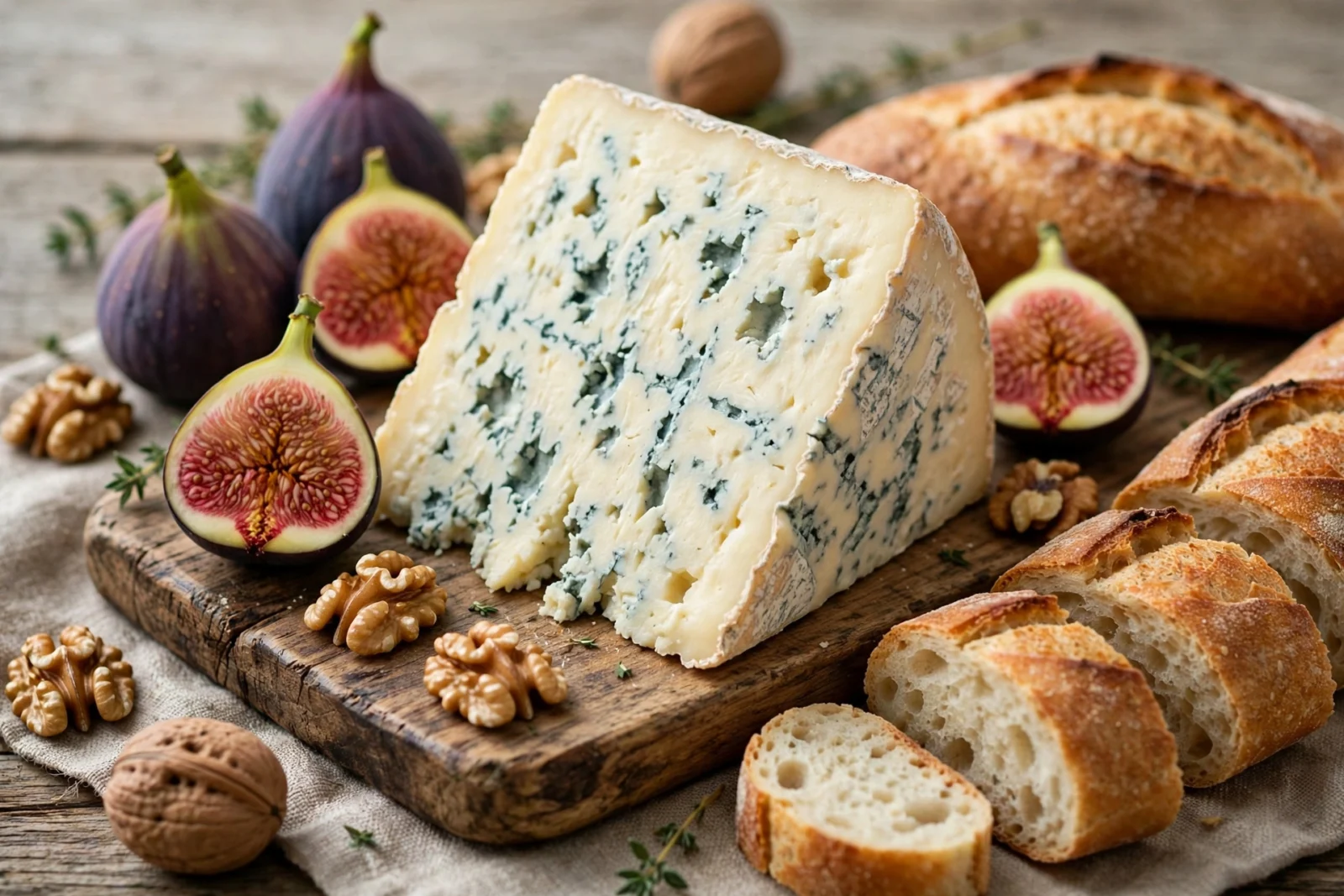
Say the word masgonzola out loud and it sounds like it has always existed. It rolls off the tongue with the same Italian music as mozzarella, gorgonzola and mascarpone, and that is no accident. The name is a blend, and so is the cheese. Masgonzola takes the cool, buttery softness of mascarpone and folds it together with the bold, blue-veined bite of gorgonzola. The result is something neither parent cheese can offer on its own: a spreadable, marbled, gently tangy cheese that even people who are nervous about blue cheese tend to enjoy.
Yet the word carries a mystery with it. Search for it and you will find food blogs, cheese guides and recipe pages, but you will not find it on the European Union’s list of protected cheeses, and no official body defines what it must be. This article explains what masgonzola is, where the idea comes from, how it is made, how to use it, and what about it is not verified.
Quick Facts: Masgonzola
What it is: A hybrid Italian-style cheese blending mascarpone and gorgonzola
Name origin: A portmanteau – “Mas” from mascarpone and “gonzola” from gorgonzola
Milk: Cow’s milk, like both of its parent cheeses
Texture: Semi-soft, creamy and spreadable, with blue-green marbling
Flavour: Buttery and mild up front, with a gentle tangy, salty blue-cheese finish
Region: Associated with Lombardy and Piedmont in northern Italy
Official status: Not a PDO or DOP cheese – the name is not protected by EU law
Best uses: Cheese boards, pasta sauces, risotto, spreads and desserts
Best pairings: Figs, pears, walnuts, honey, crusty bread, Chianti and balsamic glaze
What Is Masgonzola?
Masgonzola is a creamy Italian-style cheese that brings together two of Italy’s most famous dairy traditions. On one side sits mascarpone, the fresh, milky-white cheese made from cow’s cream, with no starter culture and no rennet, known for its silky texture and its starring role in tiramisu. On the other side sits gorgonzola, one of the world’s oldest blue cheeses, made from whole cow’s milk and ripened with blue mould until it develops its signature green-blue veins and salty, piquant depth.
When the two meet, the mascarpone softens the gorgonzola’s sharpness, and the gorgonzola gives the mascarpone a backbone it never had. The result spreads like a cream cheese, tastes like a mild blue, and looks like a work of art, with pale ivory cream threaded through with blue-green marbling.
It helps to be precise about what masgonzola is not. It is not an ancient cheese with a thousand-year pedigree of its own. It is not a protected designation of origin, and no single recipe or producer defines it. The most careful accounts describe it as a colloquial name, most commonly understood to mean “gorgonzola e mascarpone” – the two cheeses layered or blended together. Some artisan producers sell it as a single marbled cheese; others sell the two cheeses together in one tub, layered so that each spoonful carries both. Both versions travel under the same name, and that is worth knowing before you buy it.
The Two Parents: Gorgonzola and Mascarpone
To understand masgonzola, you have to understand the two cheeses that made it, because each one brings centuries of history to the table.
Gorgonzola is the older of the pair by a long way. It takes its name from the Lombard town of Gorgonzola, near Milan, where it originated, and it is believed to have been created in the 9th century. Legend tells of a distracted cheesemaker who left fresh curds overnight and, rather than throwing them away, mixed them with fresh curds the next morning. The mould that grew in the mixture turned out to be delicious, and a blue cheese was born. The town still celebrates its cheese every September at the Sagra Nazionale del Gorgonzola, a national festival in its honour.
Gorgonzola earned formal recognition in Italy as a DOC cheese in 1955, and since 1996 it has been registered as a PDO – a Protected Designation of Origin – under European Union law. That means a cheese sold as gorgonzola in the EU can only be produced in a defined list of provinces across Lombardy and Piedmont, using traditional methods. It comes in two main styles: Gorgonzola Dolce, the younger, sweeter, creamier version, and Gorgonzola Piccante, which is older, firmer, crumblier and more pungent. A third variation, marketed as “gorgonzola e mascarpone”, layers the blue cheese with delicate mascarpone – and that is the direct ancestor of the cheese this article is about.
Mascarpone is younger, but it is no less Italian. It comes from Lombardy too, traditionally from the area around Lodi or Abbiategrasso, and it rose to prominence during the Renaissance. Unlike most cheeses, mascarpone is made simply by heating cow’s cream and curdling it with citric acid. There is no ageing, no mould and no rennet. The result is a fresh cheese of extraordinary richness – smooth, mild, faintly sweet, and so soft it barely holds its shape. It is the cheese that makes tiramisu possible, and it is also the reason masgonzola feels so luxurious on the tongue.
How Masgonzola Is Made
There is no single official recipe for masgonzola, because no official body regulates it. But the methods described by artisan producers and cheese writers follow a consistent pattern.
Everything starts with cow’s milk. The gorgonzola half is made in the traditional way: whole milk is inoculated with Penicillium roqueforti, the blue mould culture behind the cheese’s marbling. The curds are cut, drained and salted, and then the young wheels are pierced with needles in a step called erborinatura, from the Milanese dialect word for the green marbling. The needle holes let air into the cheese, and the mould grows along those channels, creating the blue-green veins that give gorgonzola its look and flavour.
The mascarpone half is made very differently. Fresh cow’s cream is heated gently and curdled with citric acid, then drained until it becomes a thick, spoonable cream. It is never aged and never inoculated with mould. Its job in the blend is to bring softness, sweetness and fat – the qualities that round off the blue cheese’s edges.
The two are then brought together, and this is where producers differ. Some layer them, placing a slab of gorgonzola between two layers of mascarpone, so the finished cheese shows visible strata when you cut into it. Others blend them into a marbled whole, where ribbons of blue run through a pale, creamy body. The cheese is then aged for a short period – food writers variously describe a few weeks to several months – in temperature-controlled rooms, while the mould continues to develop gently inside the cream. Because there is no standard, the result varies from maker to maker, and that variation is the honest consequence of a cheese defined by an idea rather than a rulebook.
Flavour and Texture
If you have ever found blue cheese too strong, masgonzola is the version made for you. The first thing you notice is the texture: soft, smooth and spreadable, closer to a thick cream than to a firm cheese. It yields easily to a knife, and at room temperature it becomes almost spoonable.
The flavour follows the same gentle arc. It opens with butter and fresh cream, the mascarpone doing the talking, and then the blue notes arrive – a mild tang, a whisper of salt, a faint nuttiness – without ever turning aggressive. Where a mature gorgonzola piccante can be salty, sharp and almost spicy, this blend stays mellow. The blue veins are there in the flavour, but they are softened, as if someone turned the volume down just enough for the whole room to enjoy the music.
Cut into a wedge and you will see a pale ivory body threaded with blue-green marbling, from delicate veins to bolder patches depending on the maker and the age. Nutritionally, it inherits the profile of its parents, and that means richness. Cheese guides that publish figures for it generally describe something in the region of 360 to 400 calories and around 35 grams of fat per 100 grams, with 10 to 12 grams of protein and a fair amount of salt. Those numbers are approximate, drawn from secondary sources rather than a standardised product, so treat them as a rough guide, not a label.
Masgonzola in the Kitchen
The best thing about masgonzola is how easy it is to use. Because it is soft and spreadable, it behaves well in the kitchen in ways firmer blue cheeses do not, and it suits both savoury and sweet dishes.
On a cheese board, it is the peacemaker. Place a wedge beside a hard, salty cheese and a mild, milky one, and it bridges the gap between them, giving cautious guests a way into blue cheese without a shock. It pairs beautifully with fresh figs and sliced pears, whose sweetness balances the salt; with walnuts, whose bitterness echoes the blue notes; with a drizzle of honey or balsamic glaze; and with plain crusty bread, which lets the cheese speak for itself. A glass of Chianti is the classic partner, though a sweet dessert wine works just as well.
In cooking, it melts beautifully, which makes it a natural choice for creamy pasta sauces. Stirred into a hot pan with a splash of cream, it becomes a silky sauce for tagliatelle or gnocchi, and it is particularly good with walnuts or wild mushrooms folded through. It enriches risotto in the same way, added at the end so it melts into the rice without splitting. It also works as a filling for ravioli, a topping for bruschetta with caramelised onion, or a rich layer in a savoury tart. It has a sweet side too, inherited from the mascarpone: a spoonful with honey and figs makes a simple dessert, and beaten with cream and herbs it becomes a fine dip for crackers and raw vegetables.
A few practical notes help. It is best served at room temperature, so take it out of the fridge half an hour before eating. Keep it wrapped tightly in the coldest part of the fridge, and once opened, aim to finish it within about a week – that shelf-life figure is the one most commonly quoted by cheese guides, though it is approximate rather than standardised. Because it contains blue mould, people who are pregnant or have weakened immune systems are generally advised to check with a doctor before eating blue cheeses, particularly unpasteurised ones.
Masgonzola and Other Blue Cheeses
It helps to place masgonzola beside its relatives, because the comparison shows what makes it different. Gorgonzola itself is the obvious starting point. A gorgonzola dolce is already creamy and sweet, but it is still unmistakably a blue cheese, with a firmness and saltiness that the blend softens away. A gorgonzola piccante is sharper still, crumbly and assertive. Masgonzola sits on the gentler side of both.
Against the great blues of other countries, the difference is just as clear. Stilton is firmer and more crumbly, with a rich, almost meaty depth. Roquefort, made from sheep’s milk in the caves of southern France, is sharper, saltier and more pungent. Danish blue is creamier than Stilton but still carries a strong, salty bite. This cheese is milder than all of them, and softer too. If blue cheese is a spectrum from gentle to fierce, masgonzola sits near the gentle end, which is exactly why it works as an introduction to the style. It is also worth comparing it with the plain “gorgonzola e mascarpone” sold in Italy. In practice the two are often the same thing, and masgonzola is simply the catchier, more marketable name for the idea.
Why Masgonzola Is Being Talked About
For a cheese with no official status, masgonzola has gathered a surprising amount of attention online. Food blogs and cheese guides have published long explainers about it, search interest in terms like “mascarpone blue cheese blend” has been reported as rising, and the name now appears across recipe sites, cheese shops and social media. Some of that attention is genuine curiosity: people encounter the word, cannot place it, and want to know what it is. Some of it is the work of content creators who spotted an unusual keyword and built pages around it.
That online life is a double-edged thing. On the one hand, it has introduced a genuinely enjoyable cheese to people who might never have tried it. On the other, it has produced a wave of articles that repeat each other’s claims without checking them, including confident statements about its history, ageing time and nutritional profile that no primary source supports. The word also turns up as a username and a brand-style name in corners of the internet that have nothing to do with cheese, which only adds to the confusion.
The honest position is this: masgonzola is real in the sense that cheesemakers and cheese sellers use the name, and real in the sense that the blend it describes – gorgonzola with mascarpone – is a recognised Italian combination. It is not real in the sense of being a defined, protected, standardised cheese with a documented history. Knowing the difference is what separates a good cheese guide from a careless one. For general background on how Italian cheeses are classified and protected, Wikipedia is a useful starting point.
What Is Not Verified About Masgonzola
This section matters, because the internet is full of confident claims about masgonzola that do not survive a second look.
Its exact origin is not verified. Some food writers say it emerged in the late 20th century, when artisans began experimenting with new blends for modern palates. Others place its emergence in artisan cheese circles in the early 2000s. No primary source – no dated recipe, no producer’s record, no historical document – pins down when the name was first used or who first used it. The timing is a reasonable guess from secondary sources, but it is a guess, and this article does not present it as a settled fact.
Its status as a distinct cheese is not verified. The most careful accounts state plainly that it is not a protected designation and not a variety recognised by regulatory bodies such as the European Union’s PDO system. It is best understood as a colloquial name for a blend, not as a formal cheese in its own right. Any article that describes it as an ancient or officially recognised cheese is overstating the case.
Its ageing time is not verified. Food guides variously describe a few weeks to several months, or three to six months, but there is no standard ageing period, because there is no standard product. The same applies to its nutritional figures: the commonly quoted values of roughly 360 to 400 calories and 35 to 37 grams of fat per 100 grams come from secondary sources and vary between them, so they should be treated as approximate. Its shelf life is not verified as a fixed figure either – the commonly given advice of about seven to ten days after opening is a rule of thumb, not a standard. And claims about specific health benefits, beyond the general nutritional value of cheese, are unverified and should not be relied on.
None of this means masgonzola is a fake. It means the name describes an idea – a delicious one – rather than a regulated product, and the details around it should be read with that in mind.
Frequently Asked Questions About Masgonzola
What is masgonzola?
Masgonzola is a creamy Italian-style cheese that blends mascarpone and gorgonzola. It is semi-soft, spreadable and marbled with blue-green veins, with a buttery flavour and a gentle blue-cheese tang. It is not an officially recognised or PDO-protected cheese variety.
What does masgonzola taste like?
It tastes buttery and mild at first, like mascarpone, with a gentle tangy and slightly salty finish from the gorgonzola. It is much milder than a mature blue cheese, which makes it a good introduction to blue cheese for people who usually find it too strong.
Where does masgonzola come from?
It is associated with Lombardy and Piedmont in northern Italy, the home regions of both mascarpone and gorgonzola. Its exact origin as a named blend is unverified, with food writers variously suggesting the late 20th century or the early 2000s.
Is masgonzola the same as gorgonzola?
No. Gorgonzola is a distinct, PDO-protected blue cheese with a documented history going back to the 9th century. Masgonzola is a blend of gorgonzola and mascarpone, and it has no PDO status of its own. It is gentler and creamier than gorgonzola on its own.
How do you eat masgonzola?
Spread it on crusty bread or crackers, serve it on a cheese board with figs, pears, walnuts and honey, or melt it into pasta sauces and risotto. It is best served at room temperature, and it pairs well with Chianti or a sweet dessert wine.
Is masgonzola safe to eat?
For most people, yes, in normal portions. Because it contains blue mould, pregnant women and people with weakened immune systems are generally advised to check with a doctor before eating blue cheeses, particularly unpasteurised ones. Nutritional figures quoted for it are approximate, not standardised.
Conclusion
Masgonzola is a small story with a big flavour. It is not an ancient cheese, and it is not an official one. It is a modern idea with old roots: take two of Lombardy’s greatest cheeses, one soft and sweet, one bold and blue, and let each one fix the other’s excesses. The mascarpone tames the gorgonzola. The gorgonzola wakes up the mascarpone. What comes out is a cheese that is creamy, marbled, gently tangy and easy to love, whether you spread it on bread, melt it into pasta or set it on a board beside figs and walnuts.
That is the honest version of the story, and it is a good one without any embroidery. It does not need an invented history to be worth trying. It needs a good cheesemonger, a piece of crusty bread, and half an hour out of the fridge. The rest – the exact date it was first made, the precise recipe, the official status – is unverified, and it can stay that way. The cheese itself is the point. You can find more food guides like this one on The Night Times homepage where new features are published regularly.