
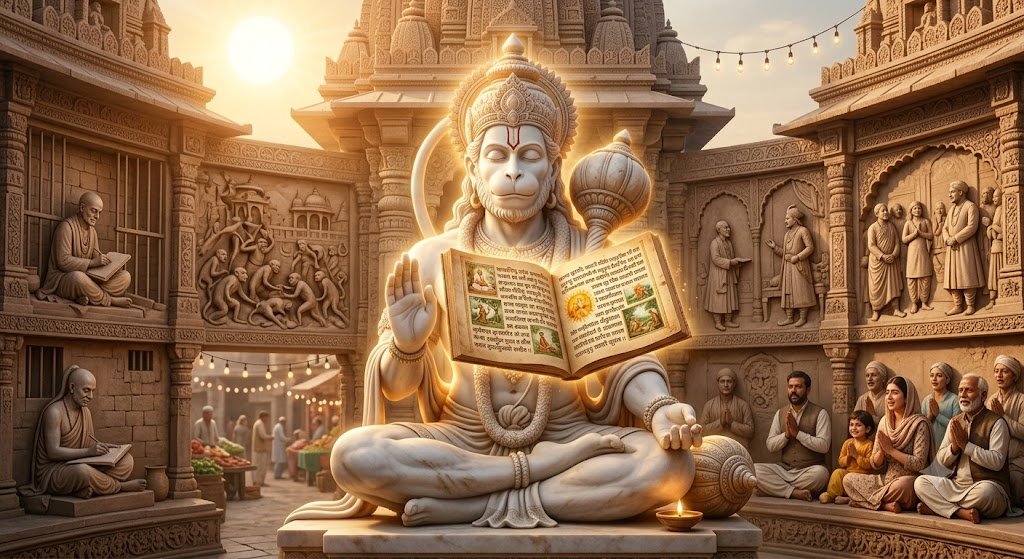
For centuries, millions of seekers around the globe have turned to a singular, rhythmic prayer during times of fear, doubt, and spiritual longing. The Hanuman Chalisa, a masterpiece of devotional poetry, is far more than a simple chant. It acts as a bridge between the restless human mind and the ultimate reservoir of courage, strength, and pure, selfless devotion.
Chanted in temples, homes, and quiet personal spaces, these forty verses have crossed geographical and cultural borders to become a global anchor for spiritual grounding. By reciting the rhythmic lines, devotees seek to invoke the qualities of Lord Hanuman—his legendary bravery, sharp intellect, and boundless loyalty to the divine.
Whether you are seeking physical vitality, mental clarity, or a deeper connection to your inner self, this sacred hymn offers a timeless sanctuary. Understanding its origins and the rich symbolism woven into its verses can transform your recitation from a habitual routine into a deeply moving meditative experience.
Hanuman chalisa lyrics
Before exploring its history, having the core verses accessible is essential for daily practice. Below is a snapshot of the composition’s foundational structure.
Quick Bio of the Hymn
| Attribute | Details |
| Primary Deity | Lord Hanuman (The incarnation of Lord Shiva / Vanara Warrior) |
| Author | Goswami Tulsidas (16th-century poet-saint) |
| Language | Awadhi (a classical dialect of Hindi originating near Ayodhya) |
| Structure | 43 verses (2 Opening Dohas, 40 Chaupais, 1 Closing Doha) |
| Core Theme | Devotion (Bhakti), courage, overcoming fear, and selfless service |
Opening Couplets (Dohas)
Shri Guru Charan Saroj Raj, Nij Manu Mukur Sudhari |
Baranau Raghuvar Bimal Jasu, Jo Dayaku Phala Chari ||
(Having polished the mirror of my heart with the dust of my Guru’s lotus feet, I sing the pure glory of the king of the Raghu dynasty, which bestows the four ultimate fruits of life: Dharma, Artha, Kama, and Moksha.)
Budheeheen Tanu Jannike, Sumiro Pavan Kumara |
Bal Buddhi Vidya Dehoo Mohee, Harahu Kalesh Vikaar ||
(Aware of my intellect’s limitations, I remember the Son of the Wind. Grant me physical strength, wisdom, and true knowledge, and wash away all my physical afflictions and mental impurities.)
Historical Origins: The Prison Cell of Tulsidas
The origin story of the Hanuman Chalisa is as dramatic as the verses themselves. Legend holds that the great poet-saint Goswami Tulsidas was imprisoned by the Mughal Emperor Akbar in Delhi. Akbar had challenged Tulsidas to perform a miracle to prove his spiritual power. Tulsidas refused, stating that he was merely a humble poet and that the only true miracle-worker was Lord Rama.
Unsatisfied, Akbar ordered Tulsidas to be locked in a stone cell. It was during this intense period of confinement and physical distress that Tulsidas poured his heart into composing forty verses praising Lord Hanuman—the ultimate remover of obstacles.
Upon the completion of the fortieth verse, an extraordinary event is said to have occurred: an army of aggressive monkeys descended upon the imperial palace and prison compound, causing absolute chaos. Recognizing the divine intervention, Akbar ordered the immediate release of the saint. This historical trial cemented the hymn’s reputation as a powerful shield against unjust imprisonment, fear, and tyranny.
The Symbolic Architecture of the Hymn
The structural layout of this prayer is designed to systematically elevate a devotee’s consciousness. It is not a random collection of praises but a carefully mapped journey.
1. Polishing the Mirror of the Heart
The very first word, “Shri,” represents the divine feminine energy and Mother Sita, whom Hanuman regarded as his supreme teacher. Tulsidas begins by acknowledging that before we can perceive the divine, we must “clean the mirror” of our own minds. If a mirror is covered in dust, it cannot reflect light. Similarly, a mind cluttered with ego, jealousy, and anger cannot experience inner peace.
2. Bridging Intellect and Energy
In the second doha, we address ourselves as “intellectually limited” (Budheeheen). This is an exercise in humility. By letting go of intellectual pride, we open up to receive three distinct graces:
-
Bal (Strength): Physical energy and structural health.
-
Buddhi (Intellect): Mental clarity and analytical power.
-
Vidya (Wisdom): Spiritual insight that goes beyond textbook learning.
3. The Metaphor of the Breath
In yogic philosophy, Hanuman is the son of Vayu (the wind god). Mystics often interpret Hanuman as a metaphor for the human breath (Prana). The human mind is like a wild monkey—constantly jumping from thought to thought. However, when that monkey is trained and dedicated to the breath, it gains the power to cross oceans of worry, quieten the inner ego, and connect directly with pure consciousness.
Practical Benefits of Regular Chanting
While many chant the prayer for its deep religious value, the acoustic and psychological benefits of reciting the verses regularly are equally profound.
                  ┌─────────────────────────────────┐
                  │ BENEFITS OF REGULAR RECITATION  │
                  └────────────────┬────────────────┘
                                   │
         ┌─────────────────────────┼─────────────────────────┐
         ▼                         ▼                         ▼
┌─────────────────┐       ┌─────────────────┐       ┌─────────────────┐
│  MENTAL FOCUS   │       │ EMOTIONAL CALM  │       │ PHYSICAL VIGOR  │
│  The rhythmic   │       │   The sound     │       │ Chanting boosts │
│   alliteration  │       │ vibrations help │       │ prana (vital    │
│ improves memory │       │ dissolve deep-  │       │ energy) to help │
│ and attention.  │       │  seated fears.  │       │ overcome lethargy.│
└─────────────────┘       └─────────────────┘       └─────────────────┘
-
Vibrational Sound Therapy: Awadhi is a highly phonetic, resonant language. The repetitive, rhythmic syllables of the quatrains act as a form of sound therapy that calms the nervous system and lowers stress hormones.
-
Dissolving Fear and Anxiety: The twenty-fourth verse states: “Bhoot pishaach nikat nahi aave, Mahavir jab naam sunave”. While traditionally understood as keeping ghosts and evil spirits away, modern psychologists view this as a powerful tool for banishing the “ghosts” of anxiety, trauma, and negative self-talk.
-
Developing Resilience: Reciting the stories of Hanuman lifting mountains and leaping across oceans instills a psychological sense of capability. It reminds us that we possess dormant inner strength waiting to be awakened.
Common Misconceptions
Despite its global popularity, several myths surround the practice of chanting this sacred hymn.
-
Misconception 1: It can only be chanted by men.
Because Hanuman is celebrated as a lifelong celibate (Brahmachari), a persistent myth suggests that women should not chant the hymn. This is entirely incorrect. Hanuman is the embodiment of motherly protection and universal love; his grace is open to every living being, regardless of gender.
-
Misconception 2: You must memorize it in Sanskrit.
The text was deliberately written in Awadhi—the language of the common folk of the 16th century—precisely so that it did not require complex classical Sanskrit training. Sincerity of heart matters far more than linguistic perfection.
-
Misconception 3: It is only for religious rituals.
Many secular individuals chant the verses purely as a mindfulness exercise to build daily discipline, enhance linguistic focus, or enjoy the calming effects of sound vibration.
A Modern Perspective: Science in the Ancient Verses
One of the most fascinating aspects of the text lies in its thirty-eighth verse:
“Yug sahasra yojana par bhanu, leelyo tahi madhura phala janu”
This verse describes a childhood story of Hanuman leaping toward the sky, mistaking the blazing sun for a sweet, ripe fruit. When you calculate the ancient Indian units of measurement mentioned in this line:
-
1 Yug = 12,000 years
-
1 Sahasra = 1,000
-
1 Yojana = 8 miles
Multiplying these figures ($12,000 \times 1,000 \times 8$) yields 96,000,000 miles. When converted to kilometers, this equals roughly 153.6 million kilometers—which is incredibly close to the actual average distance between the Earth and the Sun calculated by modern space agencies (approximately 149.6 million kilometers). For a 16th-century poet to embed this astronomical scale into a devotional quatrain remains a profound marvel for modern researchers.
Frequently Asked Questions (FAQs)
1. What is the best time of day to chant the Hanuman Chalisa?
While it can be chanted at any time, early morning (Brahma Muhurta) or evening around sunset are traditionally considered the most peaceful times to practice. Tuesdays and Saturdays are also highly favored by devotees.
2. Do I need to follow specific rules before chanting?
Ideally, one should wash their face, hands, and feet (or take a bath) and sit in a quiet, clean space. However, if you are traveling or in distress, you can silently recite it in your mind anywhere. Sincerity is the only true prerequisite.
3. Why is it called “Chalisa”?
The word “Chalisa” is derived from “Chalis,” which means forty in Hindi. This refers directly to the forty quatrain verses (chaupais) that make up the main body of the hymn.
4. Can chanting this hymn help reduce bad dreams or fear?
Yes. The sonic patterns and strong protective themes of the verses are highly effective at settling an overactive nervous system. Chanting it before sleeping is a common practice to encourage restful, fear-free sleep.
5. What is the difference between the Ramayana and the Hanuman Chalisa?
The Ramayana is a grand epic detailing the life journey of Lord Rama. The Hanuman Chalisa is a short, concentrated devotional hymn composed centuries later by Saint Tulsidas, focusing exclusively on praising the attributes and deeds of Hanuman.